





Rong Ren Goh
Portfolio Manager, Head of Macro and Thematics,
Asian Fixed Income,
Eastspring Investments
Mar 2026|5 min read


Executive Summary
- Asian bonds have remained relatively resilient compared to US and European bonds amid the recent geopolitical developments.
- Asia’s macro fundamentals have improved while many Developed Markets are experiencing high fiscal deficits and rising government debt.
- Asian bonds’ lower correlations with global bond markets during periods of market stress and still-competitive long-term returns can help improve risk‑adjusted outcomes in portfolios.
Following recent geopolitical developments, risk assets have sold off, global bond yields have moved higher to price in the inflationary impact of rising oil prices and credit spreads have widened. Yet, Asian bonds have remained relatively resilient to date, with the JP Morgan Asian Credit Index (JACI) down less than 1% year to date1. Part of this resilience, we believe, comes from Asia’s improving long-term macro fundamentals.
Investors have traditionally turned to Developed Market (DM) bonds as a key source of income. In seeking stable and predictable cash flows, income investors have viewed DM bonds as offering greater stability, credible policy frameworks, stable currencies and more durable real returns. However, this long‑held narrative has begun to shift. Asian bonds are exhibiting greater resilience as volatility rises in DM bonds.
When developed market bonds test long-held assumptions
In recent years, a pattern has emerged in which policy missteps and fiscal uncertainty have triggered weakness in both DM currencies and bonds. In November 2025 for example, the yields of UK gilts and Japanese government bonds rose sharply on the back of fiscal concerns while their currencies slipped. In the UK, the pressure came after the government signalled that planned tax increases may be rolled back, raising questions over the UK’s fiscal trajectory. In Japan, a larger than expected supplementary budget under Prime Minister Takaichi prompted a similar market response.
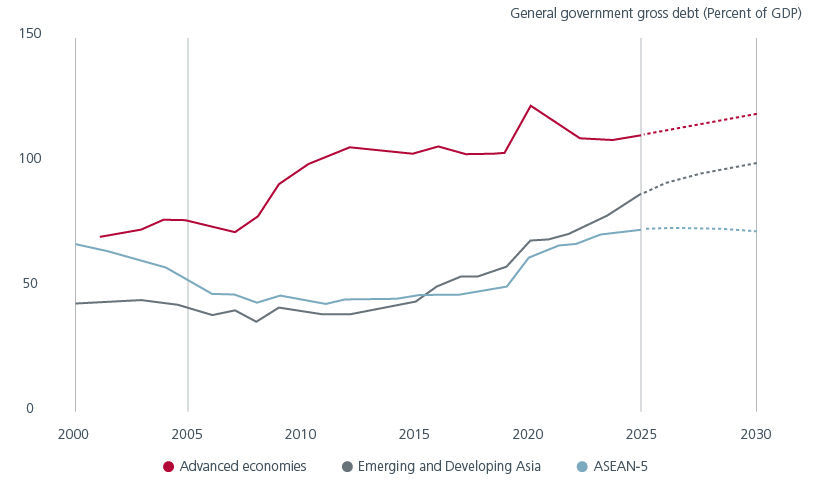
Many DMs are experiencing high fiscal deficits and rising government debt with limited political capital for fiscal consolidation. Fig. 1. When spending cuts and tax hikes are off the table and default is not an option, inflation and currency depreciation become the path of adjustment. This dynamic that used to be part of the risks associated with investing in Emerging Markets is now appearing in DMs.
Fig. 1. Advanced economies have higher government debt levels
Source: World Economic Outlook. October 2025.
On the other hand, in Emerging Asia, fiscal discipline has been steadier, and inflation better contained. Fig. 2. Policy credibility remains largely intact and real yields are positive for the right reasons. External balances are also healthier and domestic savings in the region continue to rise. Fig. 3. In the recent Middle East conflict, the current account surpluses in many Asian economies can provide some cushion to absorb higher energy costs. Meanwhile parts of Asia continue to benefit from the strong demand for AI-related exports.
Fig. 2. Headline inflation in Asia has been contained
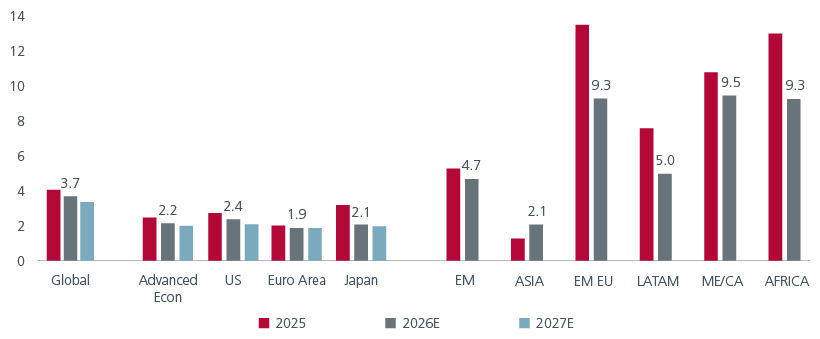
Source: IMF staff estimates. Eastspring Investments. Jan 2026. E=Expected. Any projection or forecast is not necessarily indicative of the future or likely performance. Legend: Global – World. Advanced Econ – G3 (US, Eurozone, Japan). EM – Emerging Europe. LATAM – Latin America. ME/CA – Middle East/Central Asia.
Fig. 3. 2025 Current account balances (% of GDP) in Asia looks healthy
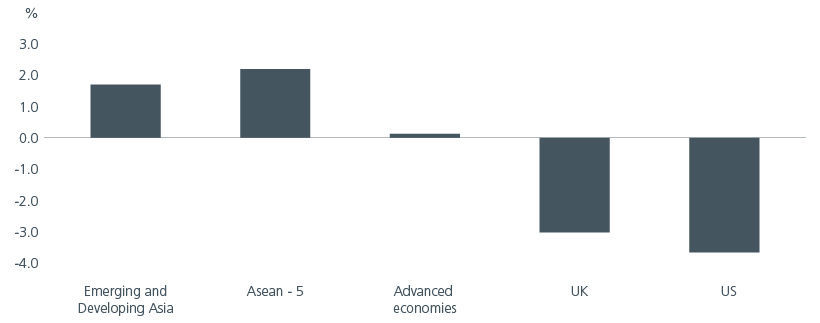
Source: IMF datamapper. Extracted on 27 February 2026. 2025 data or latest available data shown.
Although geopolitical tensions may be supportive of the USD in the near term, the dollar appears overvalued on several measures including the REER (Real Effective Exchange Rate). The US’ Net International Investment Position (NIIP) is also at its most negative level since 1975. A negative NIIP means that the foreign claims on US assets are larger than the US’ claims abroad. This extended position makes the USD potentially vulnerable and biased lower should foreign investors seek to diversify their investments and foreign reserves away from USD assets, after reassessing the US’ fiscal sustainability.
Resilience without sacrificing returns
Asian USD bonds have been able to show greater resilience during periods of market stress. This was seen during the 2022 global rates and credit sell-off, when aggressive global monetary tightening drove deep and simultaneous losses across many traditional defensive assets. Compared to global credit and government bond markets, Asian USD bonds experienced smaller peak-to-trough declines and, importantly, recovered more quickly as market conditions stabilised. Fig. 4. In the recent Iran war, Asian Investment Grade (IG) bonds have also outperformed US and European IG bonds2 month to date.
Fig. 4. Asian bonds experienced lower drawdowns in 2022
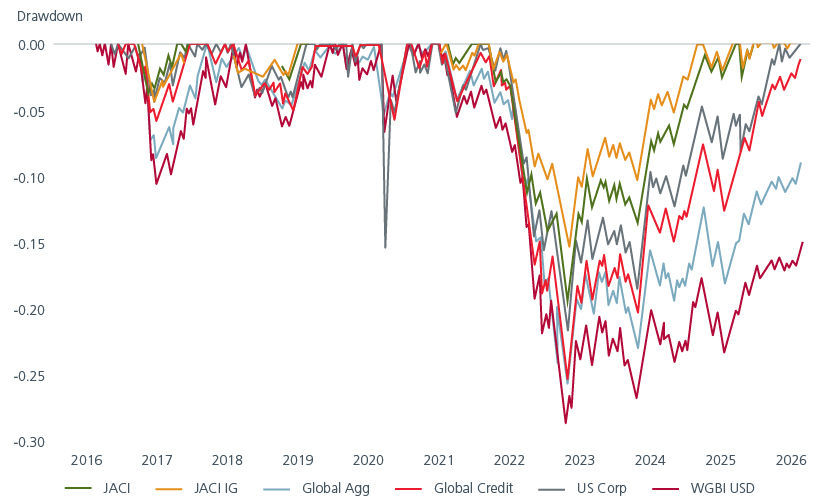
Source: Bloomberg, Feb 2026.
We have also seen correlations between Asian credit and global bond markets decline during periods of heightened stress. This differentiated behaviour can help cushion portfolios during global risk-off episodes. Fig. 5.
Fig. 5. Correlation between Asian credit and global bond markets fall during periods of market stress
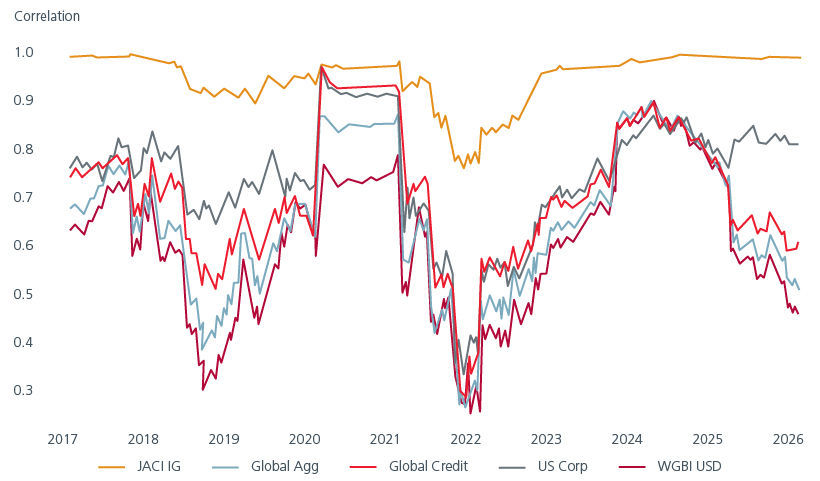
Source: Bloomberg, Feb 2026. Rolling 1-year correlation vs JACI.
Not only are Asian bonds more resilient, historically, but they have also delivered competitive long-term returns. Fig. 6. This combination is increasingly valuable as global bond markets come under pressure from sharp interest rate repricing, tighter financial conditions and periods of risk aversion. Fig. 7 shows that based on 10-year returns, adding Asian bonds to a portfolio of US or global bonds can improve the risk-return balance.
Fig. 6. Asian bonds have delivered competitive long-term returns
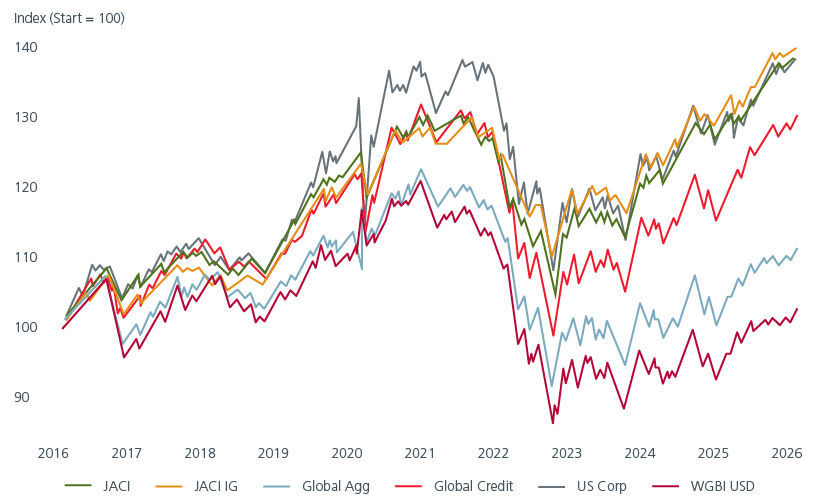
Source: Bloomberg, Feb 2026. Rebased to 100 from 2016.
Fig. 7. Adding Asian bonds can improve portfolio’s risk-return balance
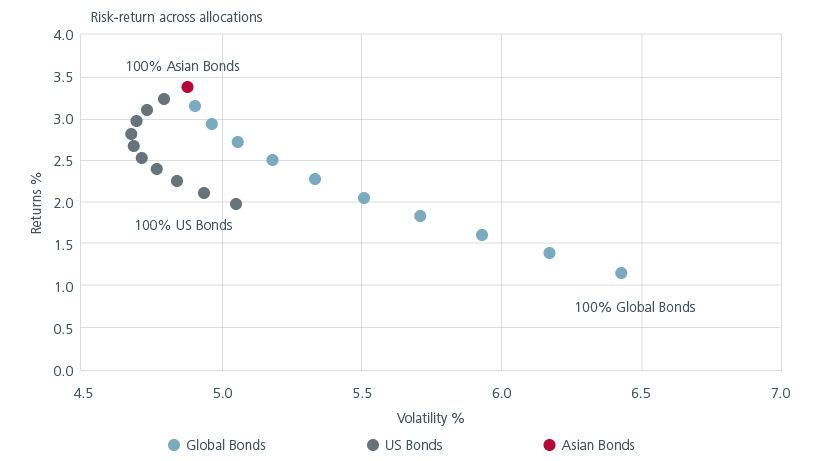
Source: Eastspring Investments. Bloomberg. Asian Bonds – JACI. US Bonds – US Aggregate. Global Bonds – Global Aggregate.
Asia’s rising role in income portfolios
The growing resilience of Asian bond markets means that Asian bonds are increasingly relevant as a core allocation within income portfolios. For long-term income investors seeking credible policy anchors and durable real returns, Asian bonds stand out as a compelling opportunity, offering diversification benefits alongside attractive real yields. Fig. 8.
Fig.8. Asia offers higher real yields than developed markets
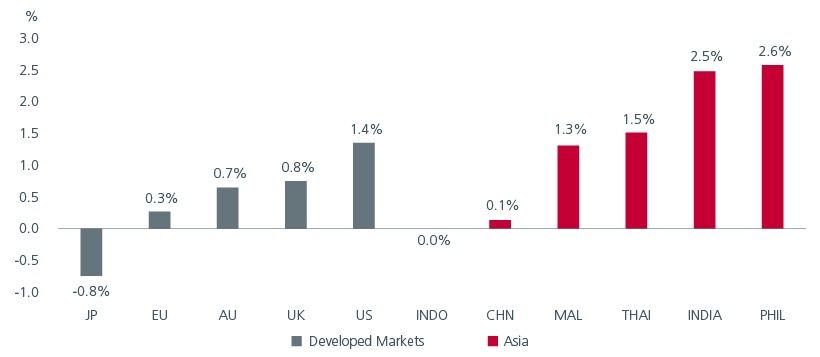
Source : Bloomberg, 10 March 2026.
In an environment marked by geopolitical tensions, policy uncertainty and shifting macro regimes, flexible bond strategies that can access both USD and local currency bond markets, as well as manage currencies dynamically, are likely to have an advantage. An active approach that navigates Asia’s diverse macroeconomic and credit fundamentals, along with differing monetary, fiscal and local market dynamics, can help investors capture income opportunities and enhance portfolio resilience, especially when it matters most.
Interesting reads











Sources:
1 Bloomberg. As of 25 March 2026.
2 Bloomberg. In USD terms. As of 26 March 2026.
The information and views expressed herein do not constitute an offer or solicitation to deal in shares of any securities or financial instruments and it is not intended for distribution or use by anyone or entity located in any jurisdiction where such distribution would be unlawful or prohibited. The information does not constitute investment advice or an offer to provide investment advisory or investment management service or the solicitation of an offer to provide investment advisory or investment management services in any jurisdiction in which an offer or solicitation would be unlawful under the securities laws of that jurisdiction.
Past performance and the predictions, projections, or forecasts on the economy, securities markets or the economic trends of the markets are not necessarily indicative of the future or likely performance of Eastspring Investments or any of the strategies managed by Eastspring Investments. An investment is subject to investment risks, including the possible loss of the principal amount invested. Where an investment is denominated in another currency, exchange rates may have an adverse effect on the value price or income of that investment. Furthermore, exposure to a single country market, specific portfolio composition or management techniques may potentially increase volatility.
Any securities mentioned are included for illustration purposes only. It should not be considered a recommendation to purchase or sell such securities. There is no assurance that any security discussed herein will remain in the portfolio at the time you receive this document or that security sold has not been repurchased.
The information provided herein is believed to be reliable at time of publication and based on matters as they exist as of the date of preparation of this report and not as of any future date. Eastspring Investments undertakes no (and disclaims any) obligation to update, modify or amend this document or to otherwise notify you in the event that any matter stated in the materials, or any opinion, projection, forecast or estimate set forth in the document, changes or subsequently becomes inaccurate. Eastspring Investments personnel may develop views and opinions that are not stated in the materials or that are contrary to the views and opinions stated in the materials at any time and from time to time as the result of a negative factor that comes to its attention in respect to an investment or for any other reason or for no reason. Eastspring Investments shall not and shall have no duty to notify you of any such views and opinions. This document is solely for information and does not have any regard to the specific investment objectives, financial or tax situation and the particular needs of any specific person who may receive this document.
Eastspring Investments Inc. (Eastspring US) primary activity is to provide certain marketing, sales servicing, and client support in the US on behalf of Eastspring Investment (Singapore) Limited (“Eastspring Singapore”). Eastspring Singapore is an affiliated investment management entity that is domiciled and registered under, among other regulatory bodies, the Monetary Authority of Singapore (MAS). Eastspring Singapore and Eastspring US are both registered with the US Securities and Exchange Commission as a registered investment adviser. Registration as an adviser does not imply a level of skill or training. Eastspring US seeks to identify and introduce to Eastspring Singapore potential institutional client prospects. Such prospects, once introduced, would contract directly with Eastspring Singapore for any investment management or advisory services. Additional information about Eastspring Singapore and Eastspring US is also is available on the SEC’s website at www.adviserinfo.sec. gov.
Certain information contained herein constitutes "forward-looking statements", which can be identified by the use of forward-looking terminology such as "may", "will", "should", "expect", "anticipate", "project", "estimate", "intend", "continue" or "believe" or the negatives thereof, other variations thereof or comparable terminology. Such information is based on expectations, estimates and projections (and assumptions underlying such information) and cannot be relied upon as a guarantee of future performance. Due to various risks and uncertainties, actual events or results, or the actual performance of any fund may differ materially from those reflected or contemplated in such forward-looking statements.
Eastspring Investments companies (excluding JV companies) are ultimately wholly-owned / indirect subsidiaries / associate of Prudential plc of the United Kingdom. Eastspring Investments companies (including JV’s) and Prudential plc are not affiliated in any manner with Prudential Financial, Inc., a company whose principal place of business is in the United States of America.