





Eastspring Investments
Apr 2026|5 min read


Executive Summary
- Special situations arise from temporary dislocations, where market sentiment turns overly negative despite underlying fundamentals remaining intact.
- India offers a particularly rich opportunity set, given its market depth, evolving corporate landscape, and transition-led mispricing.
- Special situations focus on resolution, assessing whether challenges are solvable and whether valuations adequately compensate for uncertainty.
Historically, information asymmetry was considered a key driver of alpha generation. However, with the widespread availability of information, markets worldwide, including those in India, have become much more efficient than they were a few decades ago. Yet, even in this era of transparency, inefficiencies persist. Are there blind spots in the market where superior fundamentals are overlooked, and where valuations remain misaligned with fundamentals? Special situations may create such opportunities.
Understanding special situations
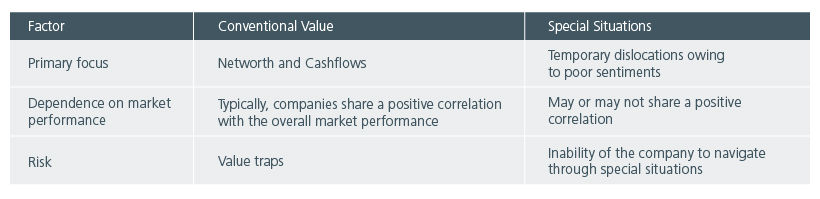
Unlike what is commonly believed, special situations are not dependent on information asymmetry. Rather, identifying a special situation means assessing an investment thesis where the market’s response is overly negative to temporary, solvable challenges faced by a company, thus providing an opportunity to invest.
Special situations can stem from a variety of developments:
1. Company-specific (e.g. unpopular acquisition)
2. Sector-wide (e.g. supply chain disruptions)
3. Regulatory actions (e.g. tariff revisions)
4. Macroeconomic shifts (e.g. commodity price shocks)
Any of the above developments can trigger a special situation for a company and result in the mispricing of a company. The actual impact, however, varies meaningfully across companies, depending on differences in business models, balance‑sheet strength, market positioning, and their ability to adapt. The opportunity to invest, however, lies in identifying those companies where underlying fundamentals remain strong, and the price dislocation reflects temporary uncertainty rather than a structural deterioration in business quality.
Spotting the opportunity
At the start of 2019, one of India’s largest conventional power producers was facing challenging times owing to regulatory overhang, difficult business conditions, and weaker performance on key operating parameters. The situation deteriorated significantly with the onset of the COVID-19 pandemic. Tightening of financing options even for mildly stressed power plants was a negative development. Under such circumstances, the market undermined the value offered by one of the India’s largest power producing companies. The valuation discount offered immense comfort. The company not only survived the challenging phase but also outlined a multi-year growth path that emphasized the importance of non-fossil energy.
As stated earlier, special situations can arise from both company-specific and sector-wide developments. For example, an unpopular large acquisition may trigger a sharp de-rating of a company, presenting an entry opportunity. When faced with such situations, the company’s management track record in integrating businesses becomes crucial. Additionally, even if traditional valuation metrics appear stretched, a strong strategic rationale and growth potential can offer a compelling margin of safety.
Similarly, sector consolidation presents opportunities. Prior to the pandemic, India’s telecom industry was beset by intense competition, high capital expenditures, and price wars. Over the years, only the strongest players survived. As the sector gradually evolved into a duopoly, it became increasingly clear that the Average Revenue Per User (ARPU) would likely rise, driven by structural factors. This shift resulted in a multi-year re-rating of the sector. While this may appear to be a classic case of re-rating-led value investing, the differentiating factor was that the growth potential of the sector seemed to have been overlooked under changing circumstances.
Fig 1: How special situations differ from conventional value investing?
Source: ICICI Prudential Asset Management Company Ltd (IPAMC)
Evaluating payoffs in special situations
Evaluating an investment’s potential payoff is key to portfolio construction. It involves assessing the conditions under which returns may materialise in the foreseeable future, helping portfolio managers allocate capital effectively and manage risk. While standard investments focus on predictable growth and fundamentals, special situations require a different lens, one that identifies temporary dislocations and mispricings.
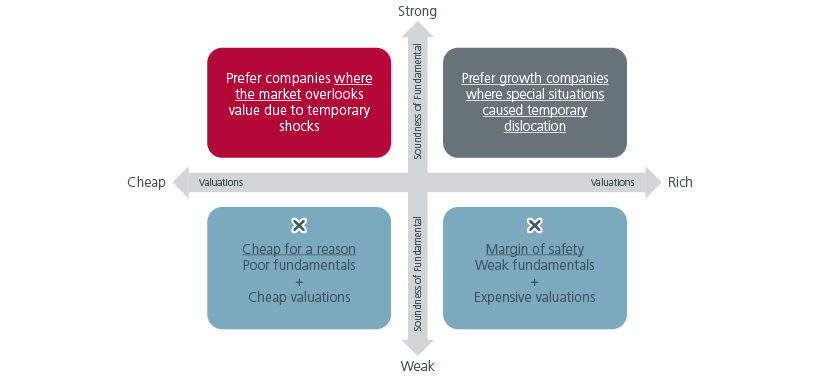
In the case of a special situation, the focus is primarily on two factors:
1) Can companies effectively navigate through special situations?
2) Have valuations and prices corrected adequately to offer a meaningful upside from the estimated intrinsic values?
In other words, the portfolio manager must evaluate the overall nature of the special situations while also estimating the upside potential of the company as these situations unfold. The nature of a special situation could be complex or simple. Similarly, there can be more than one special situation present at a given point. Assessing the ability of the company’s management team to navigate challenging situations is a qualitative aspect of special situations investing, requiring years of in-depth analysis to grasp the nuances behind management decisions.
Fig 2: Special situations payoff vs. preferences grid
Source: ICICI Prudential Asset Management Company Ltd (IPAMC)
Why India presents a compelling case for special situations?
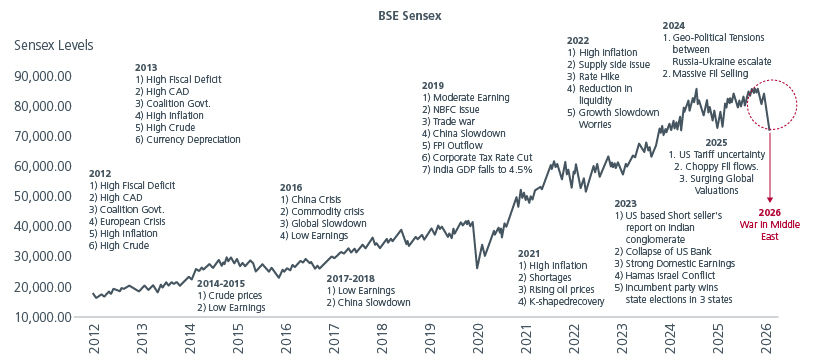
Special situations are not unique to India and are globally referred to as event‑driven investing. Indian markets have experienced numerous episodes of disruption repeatedly over time. This recurring pattern highlights that periods of heightened uncertainty are a recurring feature rather than isolated events.
Fig 3: Episodes of disruption
Source: BSE as of 31 March 2026. CAD- Current Account Deficit, NBFC- Non-Banking Financial Company, FPI- Foreign Portfolio Investment. GDP – Gross Domestic Product, Covid- Corona virus Disease.
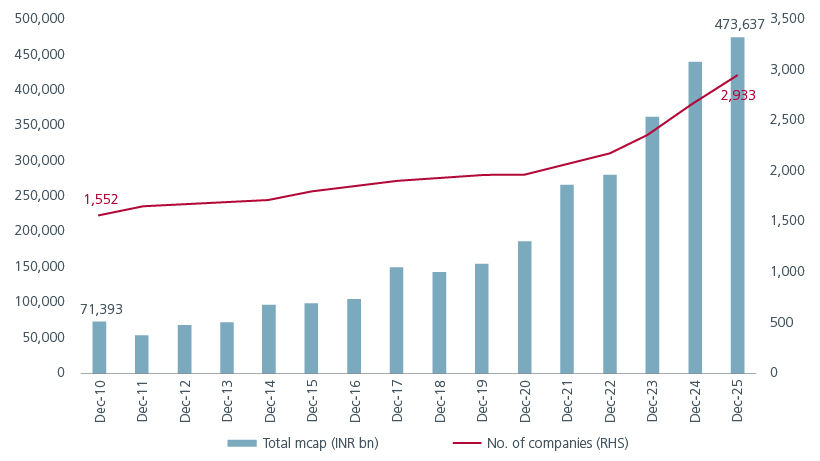
Furthermore, India offers a materially larger opportunity set; it is one of the most diversified and liquid markets globally, particularly within Asia, with over 2,900 listed companies having a total collective market cap of over USD 5 tn as of December 31, 2025.1 Over the last 15 years, India’s market cap has witnessed a 7x growth while the number of companies listed on the National Stock Exchange (NSE) have nearly doubled2. In 2018, the market cap of India’s smallest large cap i.e. that of the 100th largest company by market cap was ~INR 293 bn; at present, India’s top 250 companies individually have market capitalisation higher than INR 300 bn3.
Fig 4: Progress of Indian Market
Source: Jefferies as of 6 March 2026
Rising uncertainties due to changing geopolitical equations, the resilience of fundamentals, a unique (promoter-driven) shareholding structure, and the dynamic nature of the listed universe make India one of the uniquely positioned markets to scout for special situations.
Identifying special situations that have the potential to create alpha is a skilled task that requires a thorough understanding of both qualitative and quantitative aspects associated with these situations, as well as the companies involved. Outsized reactions create the potential for outsized returns.
This article was contributed by ICICI Prudential Asset Management Company Ltd
Interesting reads











Sources:
1 Jefferies, Dec 2025
2 Jefferies, Mar 2026
3 AMFI, Dec 2025
The information and views expressed herein do not constitute an offer or solicitation to deal in shares of any securities or financial instruments and it is not intended for distribution or use by anyone or entity located in any jurisdiction where such distribution would be unlawful or prohibited. The information does not constitute investment advice or an offer to provide investment advisory or investment management service or the solicitation of an offer to provide investment advisory or investment management services in any jurisdiction in which an offer or solicitation would be unlawful under the securities laws of that jurisdiction.
Past performance and the predictions, projections, or forecasts on the economy, securities markets or the economic trends of the markets are not necessarily indicative of the future or likely performance of Eastspring Investments or any of the strategies managed by Eastspring Investments. An investment is subject to investment risks, including the possible loss of the principal amount invested. Where an investment is denominated in another currency, exchange rates may have an adverse effect on the value price or income of that investment. Furthermore, exposure to a single country market, specific portfolio composition or management techniques may potentially increase volatility.
Any securities mentioned are included for illustration purposes only. It should not be considered a recommendation to purchase or sell such securities. There is no assurance that any security discussed herein will remain in the portfolio at the time you receive this document or that security sold has not been repurchased.
The information provided herein is believed to be reliable at time of publication and based on matters as they exist as of the date of preparation of this report and not as of any future date. Eastspring Investments undertakes no (and disclaims any) obligation to update, modify or amend this document or to otherwise notify you in the event that any matter stated in the materials, or any opinion, projection, forecast or estimate set forth in the document, changes or subsequently becomes inaccurate. Eastspring Investments personnel may develop views and opinions that are not stated in the materials or that are contrary to the views and opinions stated in the materials at any time and from time to time as the result of a negative factor that comes to its attention in respect to an investment or for any other reason or for no reason. Eastspring Investments shall not and shall have no duty to notify you of any such views and opinions. This document is solely for information and does not have any regard to the specific investment objectives, financial or tax situation and the particular needs of any specific person who may receive this document.
Eastspring Investments Inc. (Eastspring US) primary activity is to provide certain marketing, sales servicing, and client support in the US on behalf of Eastspring Investment (Singapore) Limited (“Eastspring Singapore”). Eastspring Singapore is an affiliated investment management entity that is domiciled and registered under, among other regulatory bodies, the Monetary Authority of Singapore (MAS). Eastspring Singapore and Eastspring US are both registered with the US Securities and Exchange Commission as a registered investment adviser. Registration as an adviser does not imply a level of skill or training. Eastspring US seeks to identify and introduce to Eastspring Singapore potential institutional client prospects. Such prospects, once introduced, would contract directly with Eastspring Singapore for any investment management or advisory services. Additional information about Eastspring Singapore and Eastspring US is also is available on the SEC’s website at www.adviserinfo.sec. gov.
Certain information contained herein constitutes "forward-looking statements", which can be identified by the use of forward-looking terminology such as "may", "will", "should", "expect", "anticipate", "project", "estimate", "intend", "continue" or "believe" or the negatives thereof, other variations thereof or comparable terminology. Such information is based on expectations, estimates and projections (and assumptions underlying such information) and cannot be relied upon as a guarantee of future performance. Due to various risks and uncertainties, actual events or results, or the actual performance of any fund may differ materially from those reflected or contemplated in such forward-looking statements.
Eastspring Investments companies (excluding JV companies) are ultimately wholly-owned / indirect subsidiaries / associate of Prudential plc of the United Kingdom. Eastspring Investments companies (including JV’s) and Prudential plc are not affiliated in any manner with Prudential Financial, Inc., a company whose principal place of business is in the United States of America.