






Michael (Xiaochen) Sun
Director, Quant Capability,
Client Portfolio Manager,
Quantitative Strategies,
Eastspring Investments


Executive Summary
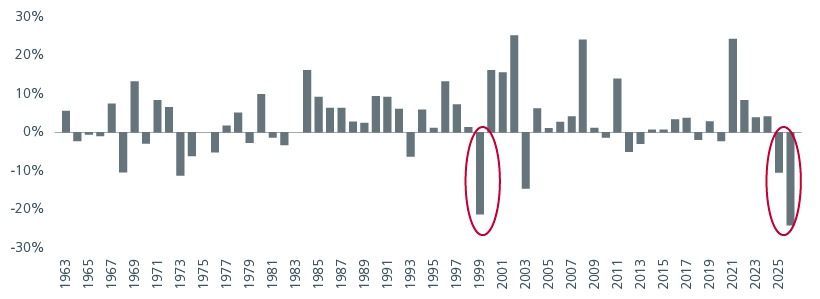
Global equity markets experienced a volatile first half, marked by no shortage of unexpected events and uncertainty. In such an environment, one might reasonably have expected companies with strong profitability, robust balance sheets and resilient earnings to navigate the turbulence relatively well. The reality, however, has been quite different. As illustrated below, the cumulative return of the Fama–French Profitability factor has fallen to levels last seen during the dot-com bubble, marking the most severe drawdown in pure profitability in the last 60 years.
Fig. 1. Quality factor experienced its largest underperformance in 60 years (US)
Source: Eastspring Investments. Kenneth R. French - Data Library https://mba.tuck.dartmouth.edu/pages/faculty/ken.french/data_library.html#Research
Why quality lost
We believe that there are three reasons why the quality factor underperformed:
1. Risk-on markets favoured cyclicals and higher beta stocks
One of the most consistent themes across sell-side and buy-side research has been the resilience of global economic activity in the face of geopolitical volatility and stubborn inflation concerns. Improving growth expectations encouraged investors to rotate into economically sensitive businesses rather than premium quality franchises. When markets believe that the economic cycle remains resilient and has further to run, the earnings momentum of cyclical businesses and the operational gearing of higher-beta stocks can offer more immediate upside than the steady compounding of quality. The defensive characteristics of quality, meanwhile, carry an implicit insurance premium that investors are often reluctant to pay in a rising market.
This pattern persisted even through March’s geopolitical shock. The conflict with Iran pushed oil above USD100 a barrel and briefly prompted a defensive rotation, during which Quality outperformed. The episode proved short-lived, however. Better-than-expected first-quarter earnings from the large US technology companies, together with upbeat guidance, quickly drew investors back towards the Artificial Intelligence (AI) trade and reinforced the prevailing risk-on backdrop.
Perhaps more strikingly, the shock itself came to be viewed as another opportunity to add exposure to economically sensitive and higher-beta assets, rather than a catalyst for a more lasting reassessment of resilience. In such an environment, Quality’s defensive and stable earnings characteristics have acted as a headwind to relative performance. We view this as a reflection of market leadership and investor positioning rather than any weakening in the fundamental case for Quality.
2. Junk rally
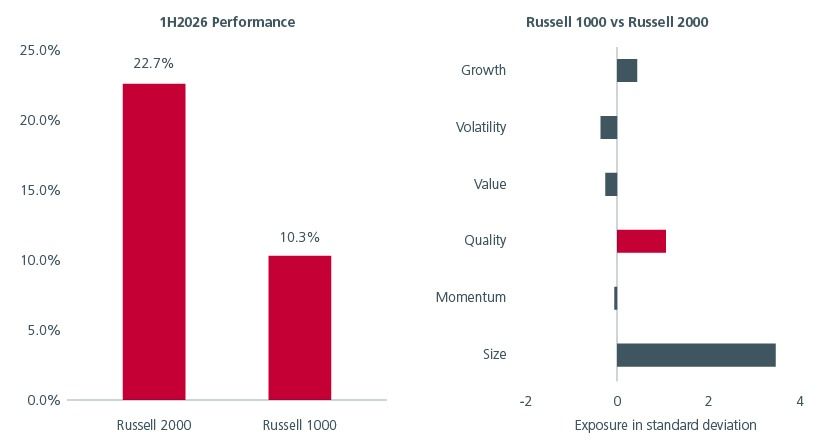
Alongside the rotation into cyclicals, markets have also staged what can best be described as a junk rally. The signs first emerged in late 2025. Several sell-side research reports highlighted the phenomenon, noting that NASDAQ-listed companies with no revenues outperformed those generating revenues, while unprofitable companies delivered roughly twice the returns of their profitable counterparts1 . The trend continued in 2026 as fears of a widely anticipated recession failed to materialise, sparking aggressive relief rallies in some of the market's most heavily beaten-down companies. This proved particularly challenging for profitability-oriented factors, as low quality and loss-making businesses led the rebound. In the US, the scale of the rotation has been striking: the Russell 2000 gained 22.7% in the first half of 2026, more than double the return of the Russell 1000, which carries a materially stronger quality bias.
Fig. 2. Russell 1000's quality bias weighed on relative returns
Source: Eastspring Investments. Bloomberg PORT. For Illustration only. As of June 2026
Combined with still-abundant liquidity, the return of speculative retail flows and the powerful AI investment narrative, the junk rally continued to gather momentum, echoing elements of the late-1990s market environment, when investors often favoured promise over proven profitability. History offers a consistent lesson: junk rallies can be powerful, but they are rarely permanent. When liquidity conditions tighten or the underlying narrative begins to falter, leadership has typically reverted swiftly towards higher-quality companies, with the subsequent recovery in quality often proving as sharp as the preceding drawdown.
3. The changing narrative of AI momentum
There is no doubt that AI-driven momentum has been the main force of 2026, in both the US and Asia Pacific. What gets rewarded is accelerating earnings and a compelling AI story, not steady profits and strong balance sheets: a company beating expectations on AI demand rises regardless of its financials, while a reliably profitable business with no AI angle gets left behind. The result has been an increasingly concentrated market, with returns driven by a narrow group of technology and semiconductor stocks. That concentration further amplified quality's underperformance. The contrast with 2023 is instructive. Market leadership was similarly concentrated among a handful of technology giants, yet quality outperformed because those leaders were themselves high quality businesses exhibiting strong profitability, robust cash generation and healthy balance sheets. This time, the picture is different. Leadership has shifted towards a broader set of AI beneficiaries, including more speculative names that many quality strategies would not own. At the same time, even the largest and most profitable technology companies began to look less "high quality" under certain factor definitions, as unprecedented AI-related capital expenditure weighed on free cash flow and returns metrics, contributing to the mega-cap sell-off in late 2025. Quality was therefore hit from both sides: underweight the market's new winners, while seeing some of its own largest holdings de-rate.
Systematic portfolio management perspective and outlook
For a multi-factor or core equity strategy, the case for maintaining exposure to quality rests on three key considerations.
First, valuation asymmetry. Quality has been one of the best-performing factors across most regions over the past decade. As a result, relative valuations reached historically expensive levels before the recent correction. The subsequent underperformance therefore appears more consistent with a partial valuation reset than with any deterioration in underlying fundamentals. When a factor's fundamental characteristics remain intact while valuations have corrected to levels not seen in years, prospective returns tend to improve. Moreover, many quality companies are still expected to deliver stronger earnings growth in 2026 than the broader market, suggesting that current valuations increasingly reflect cheapness accompanied by improving fundamentals, rather than cheapness driven by deterioration. In our view, today's entry point offers a more attractive balance between potential return and regime uncertainty.
Second, convexity to regime change. Quality has historically added value across full market cycles and remains a natural hedge against two of the most plausible downside scenarios. The first is an AI-related capital expenditure disappointment that undermines the momentum trade. The second is a deterioration in credit conditions, particularly if signs of stress emerging within private credit markets become more pronounced. In either scenario, quality companies should be relatively resilient, supported by stronger profitability, healthier balance sheets and lower leverage. This is the traditional asymmetry that quality provides, and one that has yet to be fully tested in the current cycle.
Finally, fundamental momentum. Unlike previous periods when quality relied heavily on valuation expansion to drive returns, the factor is now supported by robust underlying earnings expectations. With quality companies expected to deliver superior earnings growth in 2026, the factor no longer requires multiple expansion alone to generate attractive returns.
To conclude, factor performance is inherently cyclical. Maintaining diversified style exposures within a core equity allocation is essential for achieving resilient long-term outcomes across different market regimes. In our view, the recent underperformance of quality reflects a period of cyclical headwinds rather than a deterioration in its underlying fundamentals, leaving the factor well positioned should market leadership broaden or economic conditions become less favourable.
Interesting reads











Sources:
1https://www.wisdomtree.com/us/insights/blog/fundamentals-are-taking-a-backseat-during-the-2025-junk-rally ;
The information and views expressed herein do not constitute an offer or solicitation to deal in shares of any securities or financial instruments and it is not intended for distribution or use by anyone or entity located in any jurisdiction where such distribution would be unlawful or prohibited. The information does not constitute investment advice or an offer to provide investment advisory or investment management service or the solicitation of an offer to provide investment advisory or investment management services in any jurisdiction in which an offer or solicitation would be unlawful under the securities laws of that jurisdiction.
Past performance and the predictions, projections, or forecasts on the economy, securities markets or the economic trends of the markets are not necessarily indicative of the future or likely performance of Eastspring Investments or any of the strategies managed by Eastspring Investments. An investment is subject to investment risks, including the possible loss of the principal amount invested. Where an investment is denominated in another currency, exchange rates may have an adverse effect on the value price or income of that investment. Furthermore, exposure to a single country market, specific portfolio composition or management techniques may potentially increase volatility.
Any securities mentioned are included for illustration purposes only. It should not be considered a recommendation to purchase or sell such securities. There is no assurance that any security discussed herein will remain in the portfolio at the time you receive this document or that security sold has not been repurchased.
The information provided herein is believed to be reliable at time of publication and based on matters as they exist as of the date of preparation of this report and not as of any future date. Eastspring Investments undertakes no (and disclaims any) obligation to update, modify or amend this document or to otherwise notify you in the event that any matter stated in the materials, or any opinion, projection, forecast or estimate set forth in the document, changes or subsequently becomes inaccurate. Eastspring Investments personnel may develop views and opinions that are not stated in the materials or that are contrary to the views and opinions stated in the materials at any time and from time to time as the result of a negative factor that comes to its attention in respect to an investment or for any other reason or for no reason. Eastspring Investments shall not and shall have no duty to notify you of any such views and opinions. This document is solely for information and does not have any regard to the specific investment objectives, financial or tax situation and the particular needs of any specific person who may receive this document.
Eastspring Investments Inc. (Eastspring US) primary activity is to provide certain marketing, sales servicing, and client support in the US on behalf of Eastspring Investment (Singapore) Limited (“Eastspring Singapore”). Eastspring Singapore is an affiliated investment management entity that is domiciled and registered under, among other regulatory bodies, the Monetary Authority of Singapore (MAS). Eastspring Singapore and Eastspring US are both registered with the US Securities and Exchange Commission as a registered investment adviser. Registration as an adviser does not imply a level of skill or training. Eastspring US seeks to identify and introduce to Eastspring Singapore potential institutional client prospects. Such prospects, once introduced, would contract directly with Eastspring Singapore for any investment management or advisory services. Additional information about Eastspring Singapore and Eastspring US is also is available on the SEC’s website at www.adviserinfo.sec. gov.
Certain information contained herein constitutes "forward-looking statements", which can be identified by the use of forward-looking terminology such as "may", "will", "should", "expect", "anticipate", "project", "estimate", "intend", "continue" or "believe" or the negatives thereof, other variations thereof or comparable terminology. Such information is based on expectations, estimates and projections (and assumptions underlying such information) and cannot be relied upon as a guarantee of future performance. Due to various risks and uncertainties, actual events or results, or the actual performance of any fund may differ materially from those reflected or contemplated in such forward-looking statements.
Eastspring Investments companies (excluding JV companies) are ultimately wholly-owned / indirect subsidiaries / associate of Prudential plc of the United Kingdom. Eastspring Investments companies (including JV’s) and Prudential plc are not affiliated in any manner with Prudential Financial, Inc., a company whose principal place of business is in the United States of America.