







Hi, how can I assist?
Give me a summary of the article
Physical AI represents the next phase of the AI revolution where intelligence moves from the cloud into the real world via robots, drones and autonomous systems.
The need to process data locally on-device as well as constraints around power, size and cost in physical AI shift value toward hardware, where Asia dominates.
Asia offers investors a wider opportunity set of AI beneficiaries which includes semiconductor manufacturers, sensor makers, precision component suppliers and electronics manufacturing services providers.
What is physical AI?
Physical AI lets autonomous systems like drones, AI-smart factories, robots, and self-driving cars perceive, understand, reason, and perform complex actions in the physical world. Its impact is growing across multiple industries. Amazon’s fulfilment centres across the globe are powered by over a million robots - sorting, lifting, and transporting packages to accelerate deliveries to customers. Meanwhile, self-driving taxis are operating in more than 10 countries, and utility companies have deployed drones to inspect hazardous environments like high-voltage lines and open gas pipes. In healthcare, more than 60% of large hospitals worldwide have integrated surgical robotics into their core platforms, and robotic-assisted procedures make up more than half of complex surgeries at healthcare systems in developed countries1 .
What is the potential of physical AI?
Physical AI is still at early stages. Historically, limited real-world training data has constrained Physical AI development and most robotics solutions today still require some degree of human supervision. However, advances in simulation platforms are helping to provide synthetic training data at scale which paves the way for more autonomous Physical AI applications in the future.
As physical AI unlocks new capabilities that transform industries, the potential is significant. It is estimated that there will be 2 million humanoids (robots that look and behave like humans) in the workplace by 2035 and 300 million by 2050, creating a total addressable market between USD1.4 trillion and USD1.7 trillion2 . And this forecast does not even include other physical AI categories such as industrial/service robots, autonomous systems and drones etc.
Why would the rise in Physical AI create different winners from Generative AI?
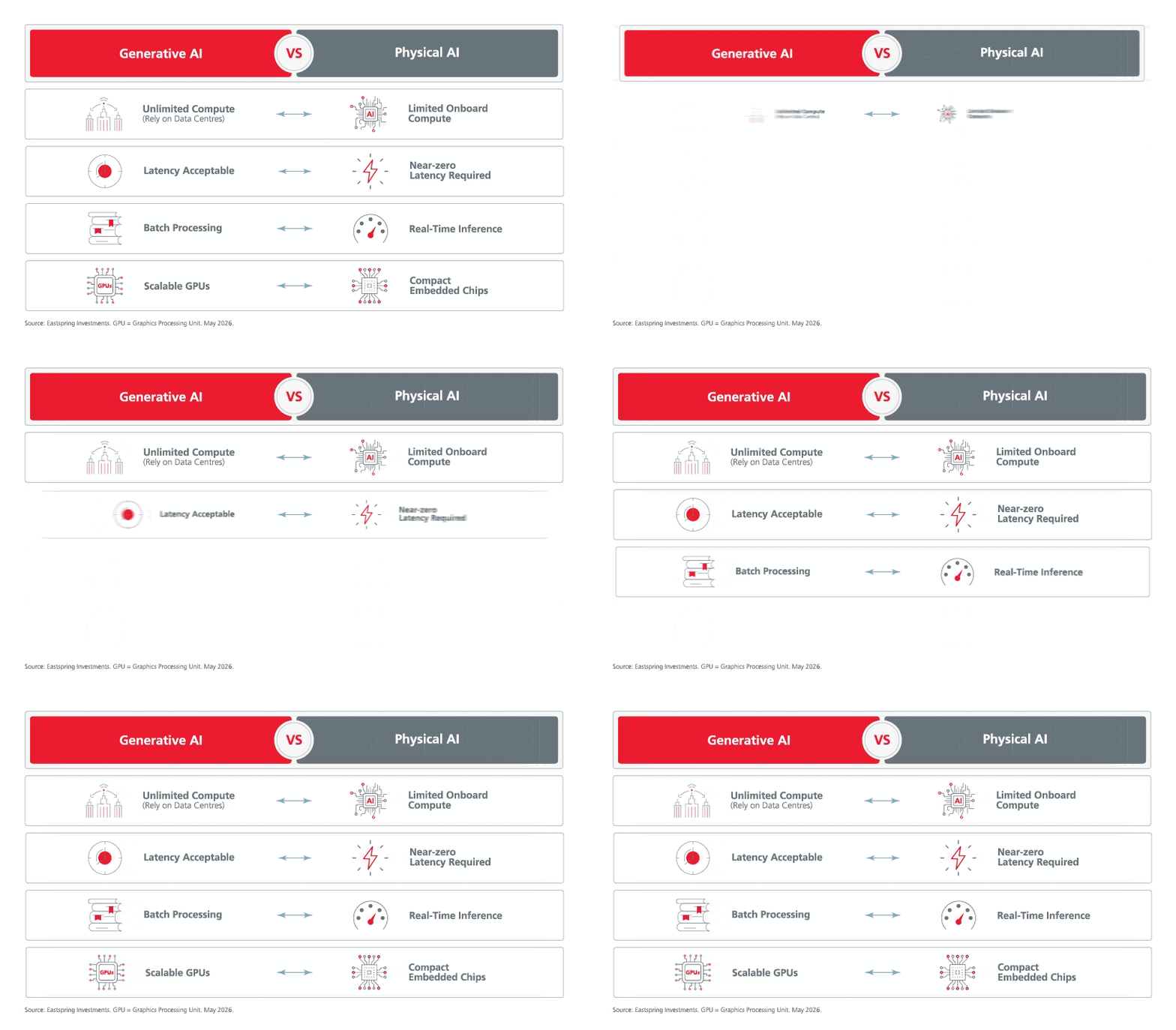
Physical AI has different requirements from Generative AI. It needs to compute on the edge [FT1.1]ie process data locally on-device instead of sending data to a centralised cloud or data center. This is because physical AI requires instant local inference to make real time autonomous decisions in order to prevent failure or safety risks. Physical AI cannot depend on network connectivity which may be intermittent or slow. Fig. 1.
Fig. 1. Requirements of Gen AI differ from Physical AI
Source: Eastspring Investments. GPU = Graphics Processing Unit. May 2026.
As a result of these requirements, physical AI faces constraints on power where it needs to balance battery life and heat management. It also faces constraints on size as compute must be embedded within the devices. There are also constraints on cost given the need to deploy at scale. These constraints shift value from software to hardware, where Asia dominates.
Does Asia have an advantage in Physical AI?
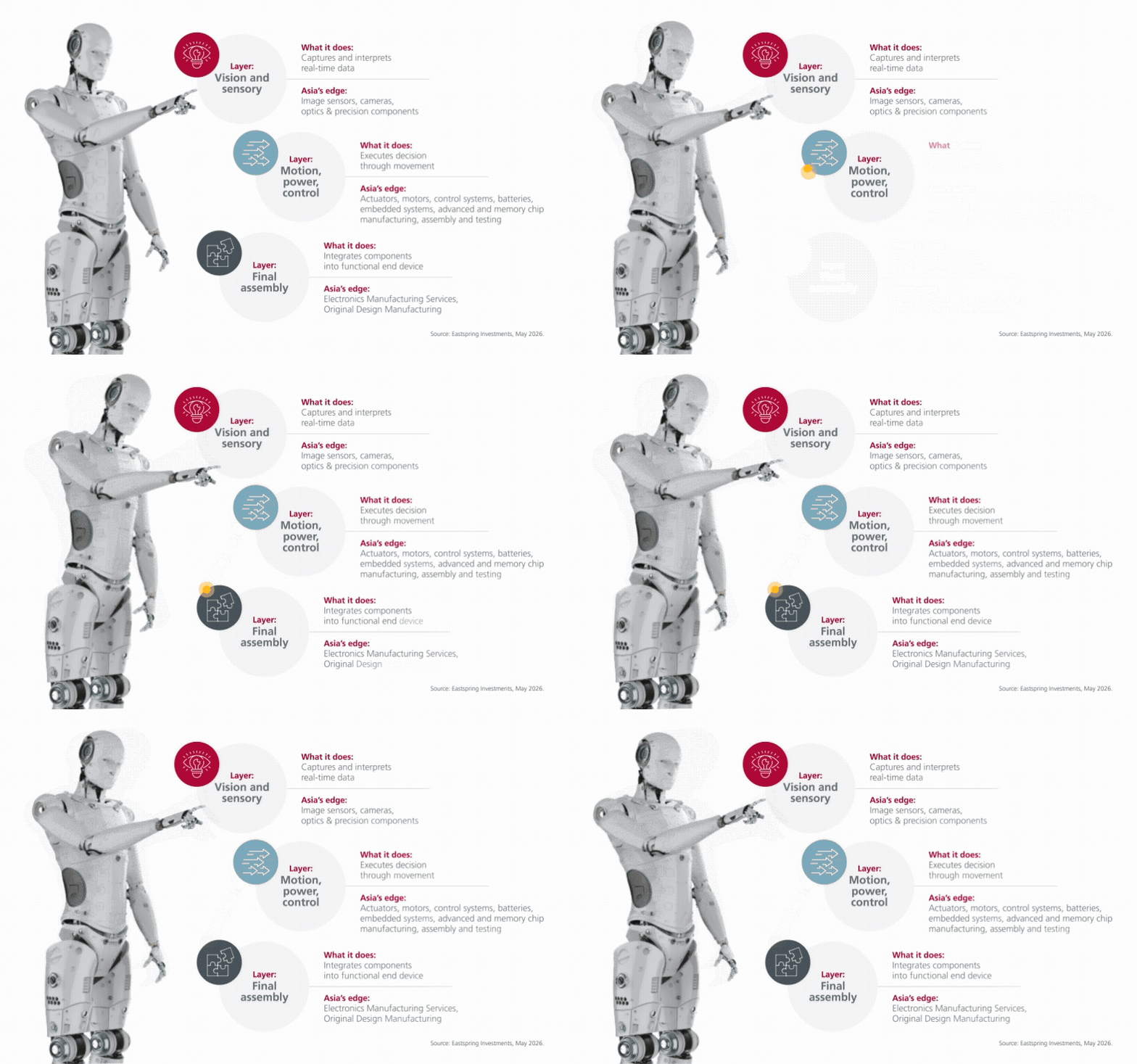
Robots, autonomous systems and industrial machines rely heavily on sensors, semiconductor chips, actuators, controls and other precision components. For robotics in particular, the development of robotic hands capable of matching the dexterity, precision and adaptability of the human hand is key. These are areas in which Asia has a competitive advantage. Fig. 2.
Fig. 2. Asia provides many of the critical components in a humanoid
Source: Eastspring Investments. May 2026.
Asia’s edge in physical AI hardware is rooted in its manufacturing depth, integrated ecosystems, and real-world deployment advantages.
First, the region benefits from decades of manufacturing expertise producing high-precision components at scale for consumer electronics. This experience enables Asian manufacturers to enjoy cost efficiencies. This is important as physical AI scales from pilot projects to mass deployment.
Second, Asia’s deeply integrated supply chains allow for faster iteration cycles, lower integration costs, and shorter lead times. This ecosystem density is important in physical AI, where close coordination between sensors, compute modules, and mechanical systems is required.
Finally, Asia’s real-world deployment environment provides a powerful feedback loop that further strengthens its competitive advantage in physical AI. As one of the world’s core manufacturing regions, Asia benefits from supportive government policies, well-established supply chains, and abundant application scenarios across factories, logistics networks, and automated production systems.
China is a good example: government initiatives have actively promoted the development of robotics and autonomous driving, while companies continue to invest in new product development and commercialisation, gradually forming a complete ecosystem spanning components, system integration, and end applications. This ecosystem not only supports the upgrading of existing manufacturing supply chains but also accelerates technology validation and market adoption through real-world use cases. Examples include the large-scale coordinated control capabilities demonstrated in the robot performance at the Spring Festival Gala, as well as humanoid robots beginning to work on production lines at electric vehicle factories. Together, these developments highlight how physical AI in Asia is moving from concept to real-world deployment.
However, despite these strengths, there are also challenges. A geographic concentration of supply chains in the region exposes production to geopolitical tensions and trade restrictions. Regulatory constraints, privacy concerns, and fragmented standards across markets may also limit scalability. At the same time, continued innovation and investment in R&D in advanced chip design, packaging and system architecture is needed to maintain Asia’s lead in edge AI optimisation.
What does the rise of Physical AI mean for investors?
Physical AI represents the next phase of the AI revolution where intelligence moves from the cloud into the real world. In physical AI, constraints around latency, power, size and cost shift value toward hardware and system integration, reinforcing Asia’s strengths. The region’s deep manufacturing expertise, tightly integrated supply chains, and real-world deployment ecosystems give it an edge in this transformation.
For investors, the opportunity set is evolving beyond Generative AI and Agentic AI beneficiaries toward Physical AI enablers, including semiconductor manufacturers, sensor makers, precision component suppliers, and electronics manufacturing services (EMS) providers, many of which are based in Asia.
As these companies navigate geopolitical tensions as well as changes to regulatory frameworks and industry standards, active investing will be needed to identify the alpha opportunities and companies that are most likely to succeed.
This article is the last in a five‑part series on the AI technology cycle and the investment opportunities in Asia as the cycle evolves and matures. Explore the full series.
Interesting reads




Sources:
1 Growth Global Insights. 13 March 2026.
2UBS. 20 June 2025.
The information and views expressed herein do not constitute an offer or solicitation to deal in shares of any securities or financial instruments and it is not intended for distribution or use by anyone or entity located in any jurisdiction where such distribution would be unlawful or prohibited. The information does not constitute investment advice or an offer to provide investment advisory or investment management service or the solicitation of an offer to provide investment advisory or investment management services in any jurisdiction in which an offer or solicitation would be unlawful under the securities laws of that jurisdiction.
Past performance and the predictions, projections, or forecasts on the economy, securities markets or the economic trends of the markets are not necessarily indicative of the future or likely performance of Eastspring Investments or any of the strategies managed by Eastspring Investments. An investment is subject to investment risks, including the possible loss of the principal amount invested. Where an investment is denominated in another currency, exchange rates may have an adverse effect on the value price or income of that investment. Furthermore, exposure to a single country market, specific portfolio composition or management techniques may potentially increase volatility.
Any securities mentioned are included for illustration purposes only. It should not be considered a recommendation to purchase or sell such securities. There is no assurance that any security discussed herein will remain in the portfolio at the time you receive this document or that security sold has not been repurchased.
The information provided herein is believed to be reliable at time of publication and based on matters as they exist as of the date of preparation of this report and not as of any future date. Eastspring Investments undertakes no (and disclaims any) obligation to update, modify or amend this document or to otherwise notify you in the event that any matter stated in the materials, or any opinion, projection, forecast or estimate set forth in the document, changes or subsequently becomes inaccurate. Eastspring Investments personnel may develop views and opinions that are not stated in the materials or that are contrary to the views and opinions stated in the materials at any time and from time to time as the result of a negative factor that comes to its attention in respect to an investment or for any other reason or for no reason. Eastspring Investments shall not and shall have no duty to notify you of any such views and opinions. This document is solely for information and does not have any regard to the specific investment objectives, financial or tax situation and the particular needs of any specific person who may receive this document.
Eastspring Investments Inc. (Eastspring US) primary activity is to provide certain marketing, sales servicing, and client support in the US on behalf of Eastspring Investment (Singapore) Limited (“Eastspring Singapore”). Eastspring Singapore is an affiliated investment management entity that is domiciled and registered under, among other regulatory bodies, the Monetary Authority of Singapore (MAS). Eastspring Singapore and Eastspring US are both registered with the US Securities and Exchange Commission as a registered investment adviser. Registration as an adviser does not imply a level of skill or training. Eastspring US seeks to identify and introduce to Eastspring Singapore potential institutional client prospects. Such prospects, once introduced, would contract directly with Eastspring Singapore for any investment management or advisory services. Additional information about Eastspring Singapore and Eastspring US is also is available on the SEC’s website at www.adviserinfo.sec. gov.
Certain information contained herein constitutes "forward-looking statements", which can be identified by the use of forward-looking terminology such as "may", "will", "should", "expect", "anticipate", "project", "estimate", "intend", "continue" or "believe" or the negatives thereof, other variations thereof or comparable terminology. Such information is based on expectations, estimates and projections (and assumptions underlying such information) and cannot be relied upon as a guarantee of future performance. Due to various risks and uncertainties, actual events or results, or the actual performance of any fund may differ materially from those reflected or contemplated in such forward-looking statements.
Eastspring Investments companies (excluding JV companies) are ultimately wholly-owned / indirect subsidiaries / associate of Prudential plc of the United Kingdom. Eastspring Investments companies (including JV’s) and Prudential plc are not affiliated in any manner with Prudential Financial, Inc., a company whose principal place of business is in the United States of America.