








Executive Summary
The recent tech sell offs have highlighted growing market concerns over the sustainability of the AI cycle. Rising funding costs, high valuations, intensifying competition and earnings uncertainty have dented investor sentiment and put returns on AI infrastructure spending much more firmly into focus. Nonetheless in our assessment, demand for AI infrastructure remains robust. At the same time, AI adoption is also broadening beyond model training and infrastructure build-out toward enterprise and consumer applications, particularly Agentic AI.
As enterprises increasingly deploy Agentic AI to grow revenue, enhance operational efficiency and improve profitability, and consumer AI applications continue to expand their user bases, we believe the commercialisation of AI remains firmly on track.
Many companies have adopted AI tools; according to Microsoft’s AI Research Institute, global AI adoption is rising. But adoption is only the starting point. The key challenge is deployment i.e. embedding AI into products, workflows and business processes at scale.
This distinction matters because monetisation is driven not by access to AI, but by its ability to generate measurable outcomes. Investors are increasingly looking for evidence that companies can convert AI usage into productivity gains, cost savings and new revenue streams. Deployment has become the critical bridge between adoption and monetisation.
Asia’s deployment advantage
Asia appears relatively well positioned as the AI cycle moves from model development towards broader deployment, although the extent to which these advantages translate into sustainable earnings will vary considerably across companies and industries.
Still Asia has some structural advantages:
First, the region sits at the heart of the global technology manufacturing ecosystem. Its semiconductor, memory, advanced packaging, server, networking and power infrastructure companies can benefit from rising AI investment before monetisation becomes visible at the software layer.
Second, Asia offers large and varied application environments. Its extensive digital platforms and integrated ecosystems can support faster deployment across areas such as commerce, financial services, gaming, customer engagement and workflow automation.
Third, Asia is strongly positioned in robotics, industrial automation and physical AI. As AI moves beyond digital applications into factories, vehicles and other physical environments, the region’s manufacturing depth could become increasingly important.
According to the Digital Realty 2026 Global Data Insights Survey, which surveyed 707 IT decision-makers across Australia, Hong Kong, India, Indonesia, Japan, Singapore, and South Korea, approximately 36% of respondents in Asia Pacific reported that AI has already generated measurable business outcomes.
Where returns are emerging today
There is growing evidence that AI is generating tangible returns across Asia’s technology sector, although the level of impact varies by industry and position within the value chain. Some of the clearest evidence of AI-related earnings has so far emerged among infrastructure and hardware suppliers, where strong investment has supported volumes, pricing and earnings.
The opportunity is also beginning to broaden. Software companies are using AI to improve productivity, shorten development cycles and automate business processes, while cloud platforms are increasingly commercialising AI services for enterprise customers.
In China, Alibaba’s Qwen large language model is being commercialised through the Bailian platform, enabling enterprise customers to deploy AI across customer service, marketing, content generation, and workflow automation. This represents one of the most tangible examples of AI monetisation through enterprise AI services and software platforms in Asia.
This suggests AI is starting to create value not only through hardware demand but also through operational efficiency and new revenue opportunities.
The next phase of monetisation
Agentic AI could represent an important test of whether rising AI usage can translate into scaled monetisation.
At present, Agentic AI deployment remains primarily enterprise-focused, with companies using it to automate multi-step workflows, process data and execute tool calls to improve operating efficiency and reduce costs.
As AI agents evolve from simply answering questions to executing tasks, AI compute architecture is likely to become more balanced across central processing units (CPUs), graphics processing units (GPUs), memory, storage and networking.
For the Asian technology supply chain, this suggests that if deployment scales successfully, potential beneficiaries could broaden beyond the current GPU-led ecosystem to other parts of the server supply chain, including CPUs, integrated circuit substrates, dynamic random-access memory, NAND/SSDs, networking, optical communications and power supplies.
Fig 1: 2026 Memory market growth estimates
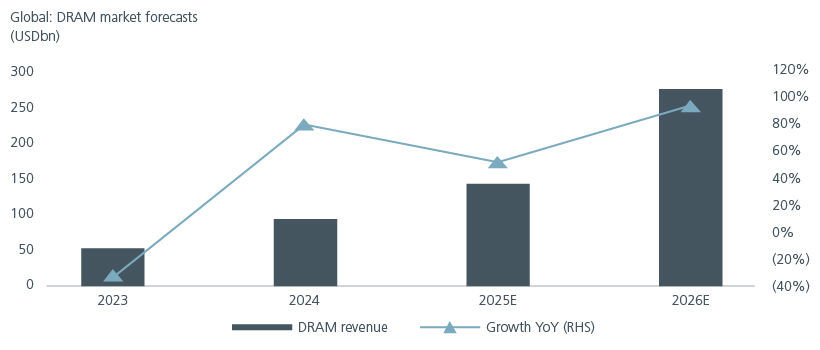
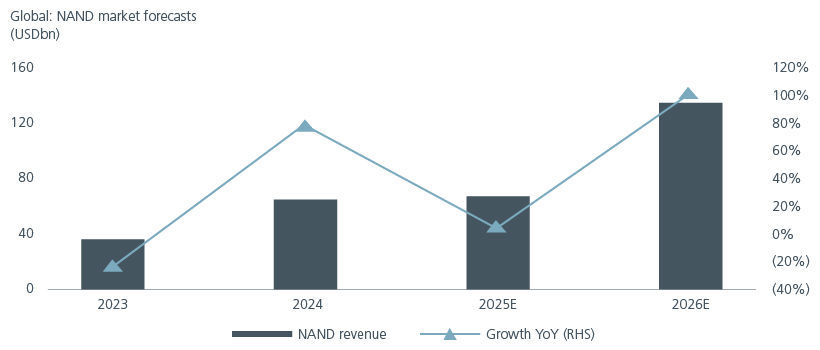
Source: Morgan Stanley, Feb 2026
Looking further ahead, the transition from digital AI to physical AI could create new opportunities across robotics, automation and autonomous driving.
What could derail monetisation
Despite the enthusiasm surrounding AI, widespread deployment does not guarantee sustainable earnings growth. Many companies are seeing growth in AI usage, but far fewer have demonstrated that customers are willing to pay more for AI-enabled products and services.
Competition could create further pressure. The rise of increasingly capable open-source models is lowering barriers to entry and accelerating the commoditisation of some AI capabilities. As AI becomes more widely available, maintaining differentiation and capturing economic value may become more challenging.
Security, governance and model reliability also remain important considerations. As AI systems become more deeply embedded in business processes and enterprise workflows, companies will need to address concerns around data security, regulatory compliance and model accuracy before deployment can scale further. In addition, rollout of AI data centres could also run into some legal and environmental hurdles.
While demand for key AI components remains strong, attention is increasingly shifting from supply constraints towards the cost and availability of capital. Higher funding costs could raise investment hurdles and place greater emphasis on capital discipline and the economics of AI infrastructure investment.
The AI investment cycle is therefore entering a more demanding phase. Opportunities continue to emerge across Asia’s technology ecosystem, but investors are likely to become increasingly selective, focusing on companies that can translate AI adoption and deployment into sustainable earnings growth and attractive returns on capital.

Interesting reads










The information and views expressed herein do not constitute an offer or solicitation to deal in shares of any securities or financial instruments and it is not intended for distribution or use by anyone or entity located in any jurisdiction where such distribution would be unlawful or prohibited. The information does not constitute investment advice or an offer to provide investment advisory or investment management service or the solicitation of an offer to provide investment advisory or investment management services in any jurisdiction in which an offer or solicitation would be unlawful under the securities laws of that jurisdiction.
Past performance and the predictions, projections, or forecasts on the economy, securities markets or the economic trends of the markets are not necessarily indicative of the future or likely performance of Eastspring Investments or any of the strategies managed by Eastspring Investments. An investment is subject to investment risks, including the possible loss of the principal amount invested. Where an investment is denominated in another currency, exchange rates may have an adverse effect on the value price or income of that investment. Furthermore, exposure to a single country market, specific portfolio composition or management techniques may potentially increase volatility.
Any securities mentioned are included for illustration purposes only. It should not be considered a recommendation to purchase or sell such securities. There is no assurance that any security discussed herein will remain in the portfolio at the time you receive this document or that security sold has not been repurchased.
The information provided herein is believed to be reliable at time of publication and based on matters as they exist as of the date of preparation of this report and not as of any future date. Eastspring Investments undertakes no (and disclaims any) obligation to update, modify or amend this document or to otherwise notify you in the event that any matter stated in the materials, or any opinion, projection, forecast or estimate set forth in the document, changes or subsequently becomes inaccurate. Eastspring Investments personnel may develop views and opinions that are not stated in the materials or that are contrary to the views and opinions stated in the materials at any time and from time to time as the result of a negative factor that comes to its attention in respect to an investment or for any other reason or for no reason. Eastspring Investments shall not and shall have no duty to notify you of any such views and opinions. This document is solely for information and does not have any regard to the specific investment objectives, financial or tax situation and the particular needs of any specific person who may receive this document.
Eastspring Investments Inc. (Eastspring US) primary activity is to provide certain marketing, sales servicing, and client support in the US on behalf of Eastspring Investment (Singapore) Limited (“Eastspring Singapore”). Eastspring Singapore is an affiliated investment management entity that is domiciled and registered under, among other regulatory bodies, the Monetary Authority of Singapore (MAS). Eastspring Singapore and Eastspring US are both registered with the US Securities and Exchange Commission as a registered investment adviser. Registration as an adviser does not imply a level of skill or training. Eastspring US seeks to identify and introduce to Eastspring Singapore potential institutional client prospects. Such prospects, once introduced, would contract directly with Eastspring Singapore for any investment management or advisory services. Additional information about Eastspring Singapore and Eastspring US is also is available on the SEC’s website at www.adviserinfo.sec. gov.
Certain information contained herein constitutes "forward-looking statements", which can be identified by the use of forward-looking terminology such as "may", "will", "should", "expect", "anticipate", "project", "estimate", "intend", "continue" or "believe" or the negatives thereof, other variations thereof or comparable terminology. Such information is based on expectations, estimates and projections (and assumptions underlying such information) and cannot be relied upon as a guarantee of future performance. Due to various risks and uncertainties, actual events or results, or the actual performance of any fund may differ materially from those reflected or contemplated in such forward-looking statements.
Eastspring Investments companies (excluding JV companies) are ultimately wholly-owned / indirect subsidiaries / associate of Prudential plc of the United Kingdom. Eastspring Investments companies (including JV’s) and Prudential plc are not affiliated in any manner with Prudential Financial, Inc., a company whose principal place of business is in the United States of America.