








Executive Summary
Japan’s investment case is entering a more demanding phase. Market drivers including easing deflation, corporate reforms and Japan’s strategic role in the global technology supply chain are now familiar with many investors. After the strong market rally since April 2025, investors are wondering if the investment case for Japan is sustainable.
Japan’s equity valuations need to be viewed alongside stronger corporate fundamentals and a changed macro backdrop of rising inflation. Despite strong earnings growth expectations for the market, we continue to see pockets where share prices understate earnings potential. Meanwhile, still high corporate cash levels, regulatory initiatives, and rising shareholder activism leave further scope for reform. Nonetheless, the next phase calls for active, non-consensus investing anchored in valuation discipline.
View valuations alongside stronger corporate fundamentals
The Japanese market is no longer as broadly undervalued as it was several years ago. The MSCI Japan Index trades at around 15.6x forward P/E1, modestly above its historical average of about 15x. Fig. 1. However, today's valuations should be viewed alongside materially stronger corporate fundamentals. Profitability and capital efficiency have improved, governance standards have strengthened, and companies are increasingly focused on capital allocation and shareholder returns. Japan's transition away from deflation has also changed the operating environment. Positive nominal growth, stronger wages and greater corporate pricing power can support structurally higher profitability than during the deflationary era.
Importantly, the headline market multiple masks considerable valuation dispersion. Some AI- and technology-related companies enjoy elevated valuations on the back of strong earnings growth and investor enthusiasm, while less-favored areas of the market continue to offer attractive stock-specific opportunities. This dispersion reinforces the importance of valuation discipline and bottom-up stock selection.
Fig. 1. 12-month forward price to earnings (x)
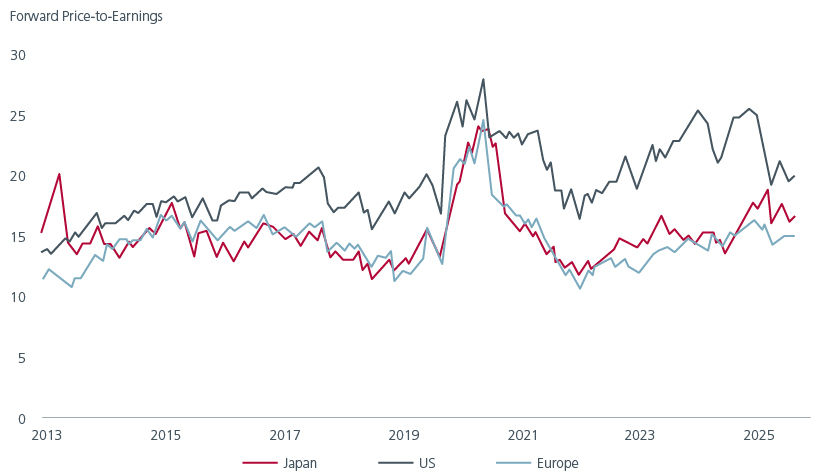
Source: Eastspring Investments (Singapore). Nomura as at 31 August 2026. Universe is MSCI Japan, US, Europe Index. The use of indices as proxies for the past performance of any asset class/sector is limited and should not be construed as being indicative of the future. Any projection or forecast is not necessarily indicative of the future or likely performance.
Meanwhile, consensus expectations point to continued earnings growth, although the outlook varies meaningfully across different parts of the market. Bloomberg consensus estimates currently point to 11.9% earnings per share growth for MSCI Japan in FY2027, compared with 25.7% for MSCI Japan Growth and 3.7% for MSCI Japan Value (data as of 19 Oct 2026).
This divergence partly reflects the different composition of the growth and value indices. The MSCI Japan Growth Index has material exposure to technology and industrial businesses that benefit from strong expectations around AI, semiconductors and data center investments. By contrast, the MSCI Japan Value Index has considerably greater exposure to financials, autos and trading companies.
The Value Index’s lower earnings growth forecast is weighed down by expectations for slower net income growth among trading companies as commodity prices peak or grow more slowly. Meanwhile, earnings from Banks and Autos are expected to be broadly in line with the MSCI Japan Index.
While AI-related businesses have a stronger earnings growth outlook, investors are already paying a premium for that growth. Current MSCI data illustrate the valuation dispersion: MSCI Japan Growth traded at 18.4x forward P/E versus 13.6x for MSCI Japan Value (as at 30 September 2026).
The key investment question, therefore, is not simply where earnings are growing fastest, but where the market may be underestimating future earnings growth relative to what is already priced in. In our view, earnings outside AI remain supported by structural and company-specific drivers, including improved pricing discipline, automation and productivity investment, restructuring and better capital allocation.
Corporate reforms still have room to run
Corporate reform has driven a multi-year transformation in Japanese equities and created significant shareholder value. While the corporate reform story is well established, we believe its value-creation potential is far from exhausted. Despite record dividends and share buybacks in 2025, Japanese companies continue to hold substantial cash reserves. Fig. 2. Reports suggest that 57.7% of TOPIX companies are net cash positive, compared with 45.7% in MSCI Asia ex-Japan, 24.3% in MSCI US and just 16.8% in MSCI Europe2 . This financial strength provides considerable optionality. Cash can be deployed into growth investments, restructuring, acquisitions, higher dividends or share buybacks as management teams become increasingly focused on return on capital.
Fig. 2. Japanese companies continue to hold substantial cash reserves
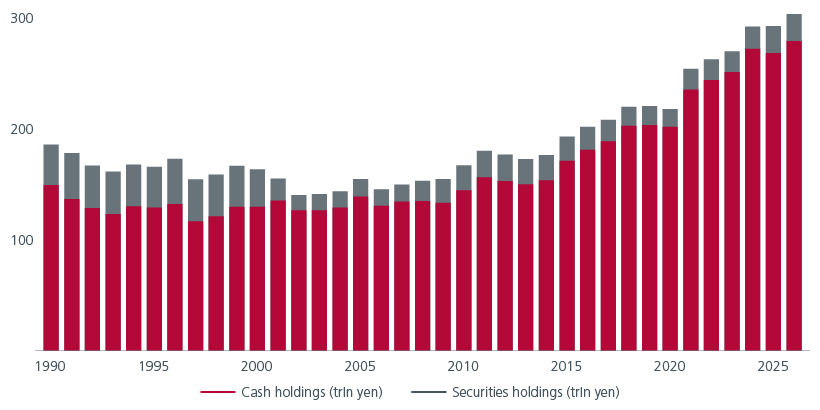
Source: CLSA Securities. Reuters. Data for 2026 is at end March.
Shareholder activism is also becoming more entrenched in Japan. Japan recorded 51 activist campaigns in 2024 - more than Europe and the UK combined3, and 56 in 20254 , second only to the US. This momentum continued in 2026. As of 8 June, activists submitted 150 proposals across 55 companies. Importantly, proposals have broadened beyond demands for excess cash distributions or board changes to encompass core strategic issues, including M&A, leveraged buyouts and fundamental portfolio restructuring5. The combination of attractive valuations, abundant corporate cash and intensifying shareholder pressure should continue to support corporate reforms and unlock value for Japanese equities.
BoJ normalisation will not derail the market rally
The Bank of Japan (BoJ) raised interest rates in June and again in September 2026, taking the policy rate to a 31-year high of 1.25%. With Japan emerging from decades of deflation and real wages beginning to rise, the BoJ is expected to continue gradual policy normalisation. The prospect of a stronger yen, however, has raised concerns about the sustainability of profits for Japanese companies, and subsequently about prospective equity market returns.
In practice, while investors’ preconception that the Japan equity market is a “weak yen trade” tends to surface during periods whenever the yen moves significantly (e.g. the yen carry trade unwinding in August 2024, Liberation Day tariff in April 2025), the correlation between market returns and the yen’s movement has not been prevalent or consistent, suggesting that fundamentals and other factors have played a bigger factor in influencing market returns.
Fig. 3. 100-day correlation between the Topix and USD/JPY
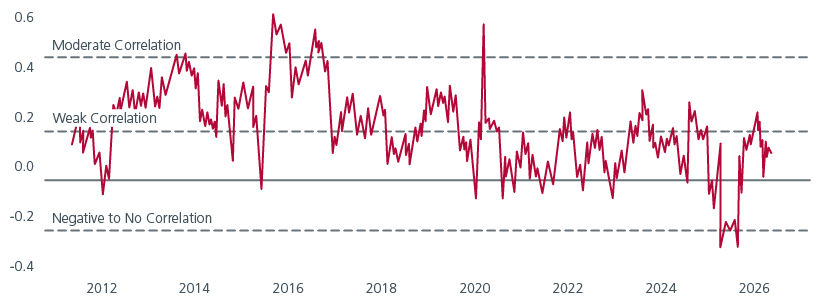
Source: Goldman Sachs Global Investment Research, Schroders, as of 12 May 2026. The use of indices as proxies for the past performance of any asset class/sector is limited and should not be construed as being indicative of the future or likely performance.
The forces behind yen appreciation as well as a stronger yen itself are not necessarily negative for Japan. Amid elevated energy prices, currency strength can help moderate imported inflation. Higher interest rates may also benefit banks and other rate-sensitive sectors, while stronger real wage growth could support consumer spending and domestically oriented companies.
Japan’s real wages rose for an eighth consecutive month in August 2026, although the improvement in household spending and consumer confidence has so far been more gradual. After several years in which rising food, energy and import prices eroded household purchasing power despite nominal wage growth, it may take time for sustained increases in real incomes to translate into greater confidence and higher discretionary spending.
Some catalysts that could help improve consumer demand include:
- Sustained real wage growth: Continued real income gains would reinforce household purchasing power and consumer confidence.
- Proposed consumption tax cuts on food: The Takaichi government has proposed to reduce the consumption tax on qualifying food from 8% to 1% for two years from April 2027, subject to parliamentary approval. If passed, this could provide more direct support to household disposable income.
- Lower imported inflation: A stronger yen and/or lower energy prices would ease pressure on household budgets, allowing wage growth to translate into real purchasing power.
The next phase of investing
Japan’s deep and diverse equity market still offers opportunities across a far broader range of industries and themes. However, as familiar market narratives become increasingly reflected in share prices, future returns are likely to depend more on identifying companies that can exceed expectations, as well as the next catalysts before they become consensus. The next phase of investing in Japan should favour active stock pickers who are willing to apply a disciplined value approach to uncover overlooked companies. Given the market backdrop, we currently see interesting opportunities in selected retail and service companies, industrials and banks. We are also finding selected opportunities among businesses exposed to AI-related investment where we believe their sustainable three-to-five-year earnings warrant meaningful upside from their current valuations. Nevertheless, with investors’ expectations having risen sharply both on AI and the broader Japan market, selectivity and valuation discipline have become increasingly important.
Interesting reads











Sources:
1 MSCI. 12-month forward Price to earnings ratio as of end September 2026.
2Nomura Research. October 2026.
32025 Japan AGM Season Review – Georgeson (Part of the Computershare group).
4How to prepare for Japan’s next wave of activism – FGS.Global.
5The Rise of Shareholder Activism in Japan and Implications for Japanese Listed Companies – Japan Research Institute. 19 May 2026.
The information and views expressed herein do not constitute an offer or solicitation to deal in shares of any securities or financial instruments and it is not intended for distribution or use by anyone or entity located in any jurisdiction where such distribution would be unlawful or prohibited. The information does not constitute investment advice or an offer to provide investment advisory or investment management service or the solicitation of an offer to provide investment advisory or investment management services in any jurisdiction in which an offer or solicitation would be unlawful under the securities laws of that jurisdiction.
Past performance and the predictions, projections, or forecasts on the economy, securities markets or the economic trends of the markets are not necessarily indicative of the future or likely performance of Eastspring Investments or any of the strategies managed by Eastspring Investments. An investment is subject to investment risks, including the possible loss of the principal amount invested. Where an investment is denominated in another currency, exchange rates may have an adverse effect on the value price or income of that investment. Furthermore, exposure to a single country market, specific portfolio composition or management techniques may potentially increase volatility.
Any securities mentioned are included for illustration purposes only. It should not be considered a recommendation to purchase or sell such securities. There is no assurance that any security discussed herein will remain in the portfolio at the time you receive this document or that security sold has not been repurchased.
The information provided herein is believed to be reliable at time of publication and based on matters as they exist as of the date of preparation of this report and not as of any future date. Eastspring Investments undertakes no (and disclaims any) obligation to update, modify or amend this document or to otherwise notify you in the event that any matter stated in the materials, or any opinion, projection, forecast or estimate set forth in the document, changes or subsequently becomes inaccurate. Eastspring Investments personnel may develop views and opinions that are not stated in the materials or that are contrary to the views and opinions stated in the materials at any time and from time to time as the result of a negative factor that comes to its attention in respect to an investment or for any other reason or for no reason. Eastspring Investments shall not and shall have no duty to notify you of any such views and opinions. This document is solely for information and does not have any regard to the specific investment objectives, financial or tax situation and the particular needs of any specific person who may receive this document.
Eastspring Investments Inc. (Eastspring US) primary activity is to provide certain marketing, sales servicing, and client support in the US on behalf of Eastspring Investment (Singapore) Limited (“Eastspring Singapore”). Eastspring Singapore is an affiliated investment management entity that is domiciled and registered under, among other regulatory bodies, the Monetary Authority of Singapore (MAS). Eastspring Singapore and Eastspring US are both registered with the US Securities and Exchange Commission as a registered investment adviser. Registration as an adviser does not imply a level of skill or training. Eastspring US seeks to identify and introduce to Eastspring Singapore potential institutional client prospects. Such prospects, once introduced, would contract directly with Eastspring Singapore for any investment management or advisory services. Additional information about Eastspring Singapore and Eastspring US is also is available on the SEC’s website at www.adviserinfo.sec. gov.
Certain information contained herein constitutes "forward-looking statements", which can be identified by the use of forward-looking terminology such as "may", "will", "should", "expect", "anticipate", "project", "estimate", "intend", "continue" or "believe" or the negatives thereof, other variations thereof or comparable terminology. Such information is based on expectations, estimates and projections (and assumptions underlying such information) and cannot be relied upon as a guarantee of future performance. Due to various risks and uncertainties, actual events or results, or the actual performance of any fund may differ materially from those reflected or contemplated in such forward-looking statements.
Eastspring Investments companies (excluding JV companies) are ultimately wholly-owned / indirect subsidiaries / associate of Prudential plc of the United Kingdom. Eastspring Investments companies (including JV’s) and Prudential plc are not affiliated in any manner with Prudential Financial, Inc., a company whose principal place of business is in the United States of America.