





Wei Ming Cheong
Portfolio Manager, Head of Life/Solutions,
Fixed income,
Eastspring Investments
Mar 2026|5 min read

Benedict Phua
Portfolio Manager,
Eastspring Singapore


Executive Summary
- SGD bonds serve as a high‑quality portfolio diversifier and balance‑sheet hedge, remaining relatively resilient during periods of market stress, including the current war‑related uncertainty.
- As developed markets’ fiscal risks rise, SGD bonds offer more reliable income with lower downside risk.
- With fundamentals intact, SGD bond returns will likely be driven by valuation and volatility, favouring an actively managed approach.
1. Do Singapore bonds continue to have a strategic role in portfolios today?
Despite heightened geopolitical uncertainty following the Iran conflict, month-to-date1 benchmark returns show that SGD bonds have held up better through the war‑related sell‑offs, with shallower declines than most other bond markets, including US bonds.
Fig 1: Singapore bonds show relative resilience amid current market sell-offs
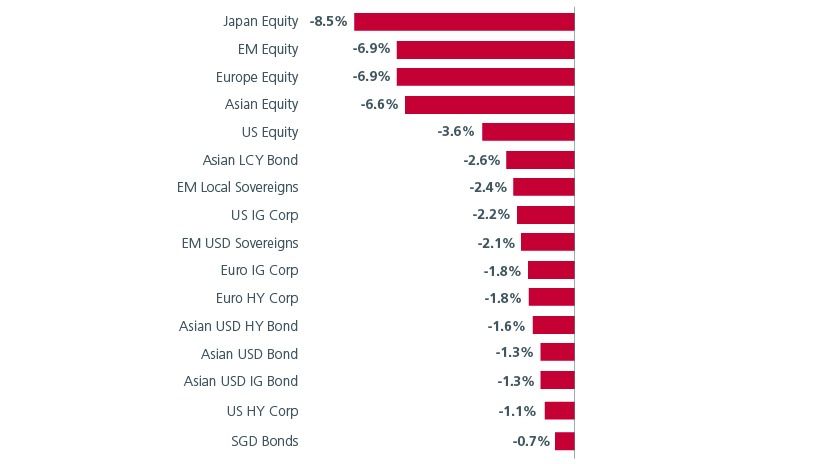
Source: Markit IBOXX Singapore Bond TRI, ICE BAML US HY Corp, JACI Investment Grade, JACI Composite, JACI Non-Investment Grade, ML Europe HY Corp, ML Europe IG Corp, EMBI Global Diversified, ICE BAML US IG Corp, GBI-EM Local, Markit iBoxx ALBI, S&P 500, MSCI AC Asia Pac ex Japan (LCY), DJ Euro Stoxx 50, MSCI Emerging Markets (LCY), Nikkei 225, as of 13 March 2026
As such, Singapore bonds are increasingly well positioned as a strategic allocation in investor portfolios, particularly as demand for high‑quality, non‑USD safe‑haven assets continues to rise. Singapore dollar (SGD) bonds have attracted sustained global inflows, underpinned by their meaningful diversification benefits and consistently low correlation with broader risk assets. From a portfolio‑construction perspective, their relatively lower volatility profile can help support more stable portfolio outcomes and potentially improve a portfolio’s risk-return profile across market cycles
Fig 2: SGD bonds offer diversification benefits within multi asset portfolios

Source: Bloomberg as at 28 Feb 2026 based on 10-year monthly correlation data. Singapore Bonds represented by Markit iBoxx ALBI Singapore (SGD), 10Y US Treasury represented by the generic 10Y US Treasury Note futures, Asian USD Bonds represented by the JP Morgan Asia Credit Index (USD), Asia ex-Japan Equities represented by MSCI AC Asia ex Japan (USD), Singapore Equities represented by MSCI Singapore Index (SGD).
Importantly, SGD bonds can potentially be a complementary allocation in global portfolios. US Treasuries continue to serve as the world’s primary risk‑free asset and tactical risk‑off tool. Singapore government bonds too serve a similar role: a high‑quality (AAA‑rated) sovereign bond which is a portfolio diversifier and strong balance‑sheet hedge during periods of market stress.
SGD bonds (both sovereign and corporate) are better positioned as income generating capital‑preservation assets, particularly at a time when global fiscal sustainability is under increasing scrutiny. Income consistency is becoming more valuable and exposure to investment‑grade SGD bonds has the potential to deliver steady income with less downside risk.
This distinction has become more pronounced amid rising concerns over developed markets’ fiscal sustainability. With US President Trump likely to pursue expansionary policies ahead of the November mid‑term elections, the US’ projected FY2026 fiscal deficit of around US$1.9 trillion (~5.8% of GDP), suggests heavy Treasury supply, greater long‑end issuance and a steeper yield curve.
Against this backdrop, US Treasuries are likely to experience heightened volatility. By contrast, Singapore is expected to post a fiscal surplus of around S$8.5bn (~ 1% of GDP) in 2026, limiting supply pressures and helping to anchor bond yields and volatility, and thereby reinforcing the role of Singapore bonds as a stabilising force within global portfolios.
2. How compelling are Singapore government bonds relative to other bond markets?
2025 was a standout year for SGD government bonds. Falling SGD government yields, set against a backdrop of rising long‑end yields across several G3 markets, drove strong performance. This rally coupled with spread compression of SGD corporate bonds, however, raises questions on whether SGD bonds remain attractive.
When considering valuations, it is important to adjust yields to make it an apples-to-apples comparison. While Singapore bond yields may seem low on a nominal basis, they are considered fair to regional and global peers after adjusting for their cross-currency basis.
Market liquidity further reinforces Singapore bonds’ relative appeal. The SGD bond market is consistently recognised as one of the most developed and liquid in Asia, underpinned by deep and stable domestic institutional demand as well as robust retail participation. In contrast, many regional local currency bond markets are more sensitive to foreign flows, currency fluctuations and tend to experience sharper sell‑offs during risk‑off episodes.
Overall, the case for Singapore bonds rests on high credit quality and a favourable risk-return profile, which positions Singapore bonds as a high‑quality anchor within regional and global portfolios. Looking ahead, Singapore’s political stability and prudent fiscal and monetary policies should support steady performance in 2026, although returns are likely to normalise to around 2.5%–3.5%, following the exceptional 7%–8% gains (SGD terms) seen in 2025.
3. Which macro and policy drivers are likely to drive SGD bond returns?
Beyond fiscal discipline, the Monetary Authority of Singapore’s (MAS) monetary policy stance which is anchored on maintaining medium-term price stability is a key driver of SGD bond returns. To date, MAS has left policy settings unchanged, maintaining the slope of the SGD Nominal Effective Exchange Rate (NEER) policy band at 0.5% per annum.
From a policy perspective, MAS expects the output gap to remain positive, even as growth normalises and moderates to 2–4% in 2026 after expanding 5% in 2025. Inflation remains well contained, although MAS recently raised its inflation forecast to 1%–2% from 0.5%–1.5%. While the outlook appears stable for now, upside growth surprises or renewed geopolitical shocks (sustained rise in energy price or supply-chain disruption amid military conflict in the Middle East) could still pose risks to the inflation trajectory.
The upward revision in inflation forecasts increases the likelihood of policy tightening as early as April. Any tightening will result in a stronger SGD, potentially attracting more increased capital inflows and a steeper SGD yield curve.
Separately, the US Fed’s rate moves in the coming months could influence risk sentiment and term premia. Nonetheless SGD bonds tend to respond more modestly to US Treasury moves and curve repricing is often more muted than in G3 markets. This makes SGD bonds more resilient during periods of sharp Fed‑driven volatility.
MAS operates a managed float regime for the SGD. The SGD is relatively controllable through direct interventions in the foreign exchange markets and bears a stable and predictable relationship with price stability as the final target of policy over the medium term. Barring material change to the macro fundamental outlook, MAS is expected to maintain an appreciating SGD policy. Coupled with a weaker USD outlook over the medium term to long term, there is potential for further upside via the exposure in SGD currency. SGD-based investors who already have USD exposure may want to consider hedging some of their USD exposure.
4. Where are the best opportunities across duration and SGD credits?
Balancing between the front-end of the rates curve which is at multi-year lows versus the longer end of the curve who holds more duration risk, we find the belly of the curve (3 to 7 years) to offer the most compelling value today, where investors are better compensated for duration risk. Our current view would change if valuations improve or macro conditions shift.
As for credits, we prefer statutory board bonds, as well as high quality financial and corporate bonds which have lagged the SGS rally. Statutory board bond spreads versus Singapore government bonds look attractive at current levels.
5. What are the main risks facing SGD bonds?
Risks are skewed toward higher volatility and valuation sensitivity rather than a deterioration in credit fundamentals. Spreads are tight in certain parts of the market, and wide in others. On balance, SGD spreads are probably fair to slightly wide.
A key point to note is that many SGD bonds continue to be unrated by international credit rating agencies. Hence it is important to have boots on the ground to carry out in-depth credit research. In addition, bond demand-supply mechanics and market technicals shape bond pricing and having long expertise in this market is a useful advantage. This reinforces the case for active duration and risk management.
Interesting reads











Sources:
1 As of 13 March 2026
The information and views expressed herein do not constitute an offer or solicitation to deal in shares of any securities or financial instruments and it is not intended for distribution or use by anyone or entity located in any jurisdiction where such distribution would be unlawful or prohibited. The information does not constitute investment advice or an offer to provide investment advisory or investment management service or the solicitation of an offer to provide investment advisory or investment management services in any jurisdiction in which an offer or solicitation would be unlawful under the securities laws of that jurisdiction.
Past performance and the predictions, projections, or forecasts on the economy, securities markets or the economic trends of the markets are not necessarily indicative of the future or likely performance of Eastspring Investments or any of the strategies managed by Eastspring Investments. An investment is subject to investment risks, including the possible loss of the principal amount invested. Where an investment is denominated in another currency, exchange rates may have an adverse effect on the value price or income of that investment. Furthermore, exposure to a single country market, specific portfolio composition or management techniques may potentially increase volatility.
Any securities mentioned are included for illustration purposes only. It should not be considered a recommendation to purchase or sell such securities. There is no assurance that any security discussed herein will remain in the portfolio at the time you receive this document or that security sold has not been repurchased.
The information provided herein is believed to be reliable at time of publication and based on matters as they exist as of the date of preparation of this report and not as of any future date. Eastspring Investments undertakes no (and disclaims any) obligation to update, modify or amend this document or to otherwise notify you in the event that any matter stated in the materials, or any opinion, projection, forecast or estimate set forth in the document, changes or subsequently becomes inaccurate. Eastspring Investments personnel may develop views and opinions that are not stated in the materials or that are contrary to the views and opinions stated in the materials at any time and from time to time as the result of a negative factor that comes to its attention in respect to an investment or for any other reason or for no reason. Eastspring Investments shall not and shall have no duty to notify you of any such views and opinions. This document is solely for information and does not have any regard to the specific investment objectives, financial or tax situation and the particular needs of any specific person who may receive this document.
Eastspring Investments Inc. (Eastspring US) primary activity is to provide certain marketing, sales servicing, and client support in the US on behalf of Eastspring Investment (Singapore) Limited (“Eastspring Singapore”). Eastspring Singapore is an affiliated investment management entity that is domiciled and registered under, among other regulatory bodies, the Monetary Authority of Singapore (MAS). Eastspring Singapore and Eastspring US are both registered with the US Securities and Exchange Commission as a registered investment adviser. Registration as an adviser does not imply a level of skill or training. Eastspring US seeks to identify and introduce to Eastspring Singapore potential institutional client prospects. Such prospects, once introduced, would contract directly with Eastspring Singapore for any investment management or advisory services. Additional information about Eastspring Singapore and Eastspring US is also is available on the SEC’s website at www.adviserinfo.sec. gov.
Certain information contained herein constitutes "forward-looking statements", which can be identified by the use of forward-looking terminology such as "may", "will", "should", "expect", "anticipate", "project", "estimate", "intend", "continue" or "believe" or the negatives thereof, other variations thereof or comparable terminology. Such information is based on expectations, estimates and projections (and assumptions underlying such information) and cannot be relied upon as a guarantee of future performance. Due to various risks and uncertainties, actual events or results, or the actual performance of any fund may differ materially from those reflected or contemplated in such forward-looking statements.
Eastspring Investments companies (excluding JV companies) are ultimately wholly-owned / indirect subsidiaries / associate of Prudential plc of the United Kingdom. Eastspring Investments companies (including JV’s) and Prudential plc are not affiliated in any manner with Prudential Financial, Inc., a company whose principal place of business is in the United States of America.