








Executive Summary
This is an extract from Eastspring Investments’ “Emerging Market Debt: Opportunities, positioning & risks; A practical guide for investors.”. Click here to download the full report.
For much of the decade following the Global Financial Crisis and especially during 2020-2021, historically low Developed Market (DM) bond yields have prompted investors to seek income from higher yielding asset classes. Today, although DM yields have risen, it does not diminish the investment case for Emerging Market Debt (EMD). The EM-DM distinction has blurred and beyond yields, EMD can provide additional sources of return, increased diversification and greater alpha generation.
The blurring distinction between EM and DM
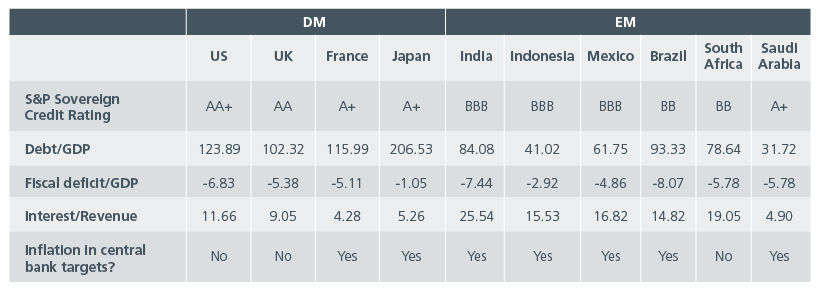
Over the years, many EM economies have lowered their debt burdens, improved their inflation credibility and strengthened their growth prospects. On the other hand, many DMs are increasingly weighed down by rising fiscal risk, inflation uncertainty and bond supply pressures. Fig. 1. As such, DM bonds may not always provide the same defensive role they have historically played in investor portfolios.
Fig. 1. Improving EM fundamentals is blurring the distinction between EM-DM
Source: Eastspring Investments, S&P Global Ratings, Bloomberg, respective Sovereign’s central bank website. Estimates as of 14 July 2025.
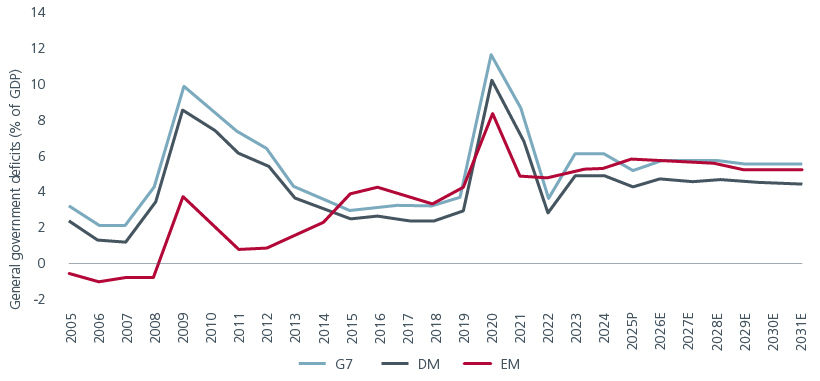
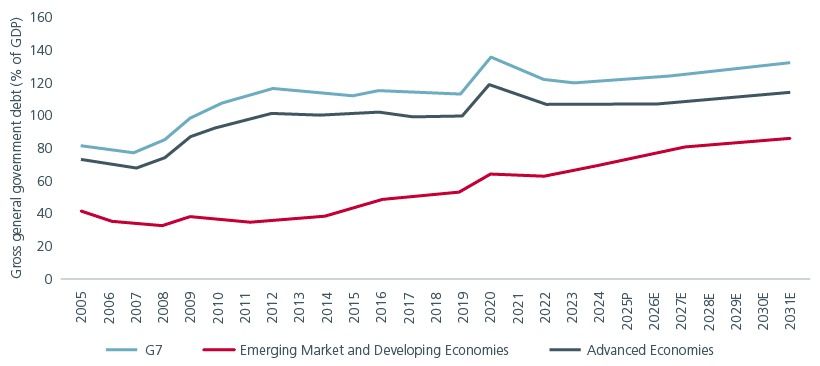
Lower debt burdens. Developed market yields have risen partly because of growing concerns over fiscal and debt sustainability. The International Monetary Fund expects G7 fiscal deficits to stay elevated and for their gross government debt to GDP ratio to rise significantly over the coming years as social and defense spending increases.
In contrast, EM governments, while not immune to fiscal pressures, are generally expected to remain less indebted than DMs. Some EM countries had pursued more measured post-pandemic fiscal support, which reduced inflation persistence, allowing central banks to regain policy flexibility earlier. Fig. 2 and 3.
Fig. 2. EMs’ fiscal deficit peaked at 8% of GDP post COVID
Source: Eastspring Investments, IMF World Economic Outlook, April 2026.
Fig. 3. EMs expected to be less indebted than DMs
Source: Eastspring Investments, IMF World Economic Outlook, April 2026.
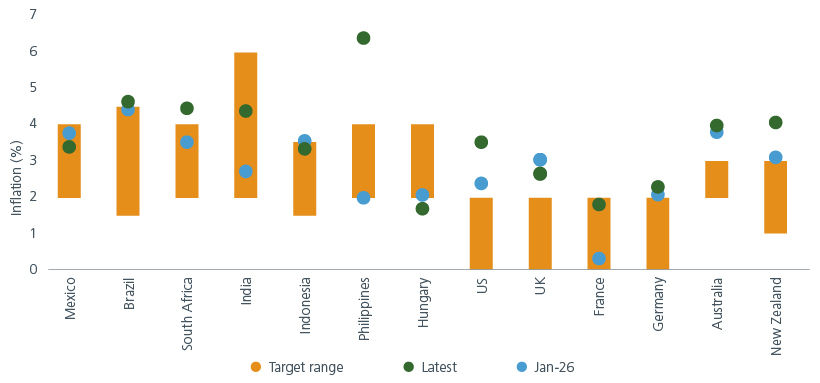
Improved inflation credibility. Although the Middle East conflict has added to inflationary pressures globally, the inflation rates across most major EMs remain within communicated central bank ranges except for selected economies which are more vulnerable to higher energy prices e.g. Philippines. Over the past years, several large EM central banks have also lowered/narrowed their inflation target ranges which have contributed to greater currency stability, making their local debt markets more attractive. On the other hand, inflation in several DMs is above target. DM’s larger fiscal needs and structurally higher social spending may also challenge the path to sustainably lower inflation. Fig. 4.
Fig. 4. Inflation across major EMs remain within central bank target ranges
Source and date: Eastspring Investments, Bloomberg, respective central bank websites. As of 22 July 2026.
Favourable growth prospects. EMs’ growth prospects are underpinned by favourable demographics, productivity catch-up, commodity endowments, manufacturing depth, digitalisation and regional reform stories. Over the next 5 years to 2031, EMs are expected to:
- Grow by an average of 2.4% p.a. faster than DM economies
- Generate almost 75% of nominal global growth
- Expand population 3x faster than DMs
- Drive majority of new global consumption and middle-class growth
- Gain market share in global manufacturing and trade
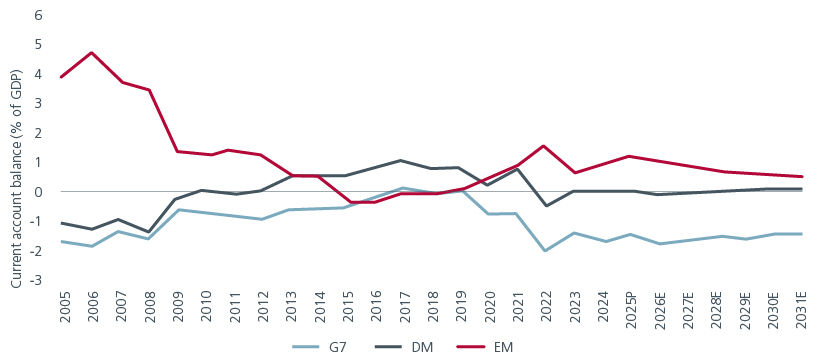
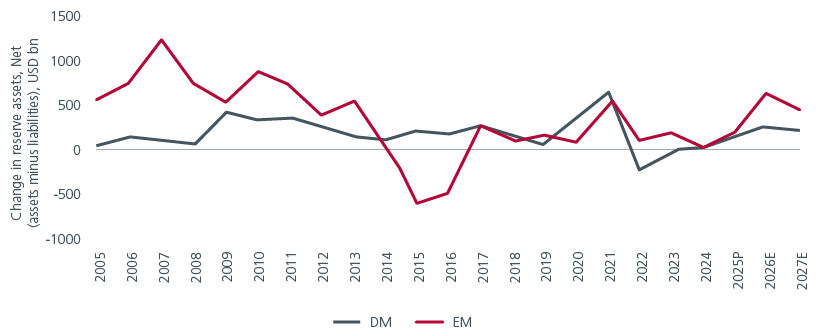
Improving growth prospects and rising exports have helped EMs’ current account balances and net reserve assets trend up since 2015. Fig. 5 and 6. On the other hand, the Group of 7 has increasingly exhibited signs of external imbalances.
Fig. 5. EMs’ current account balances have improved since 2015
Source: Eastspring Investments. IMF World Economic Outlook, April 2026.
Fig. 6. EMs’ net reserves have been rising since 2017
Source: Eastspring Investments. IMF World Economic Outlook, April 2026.
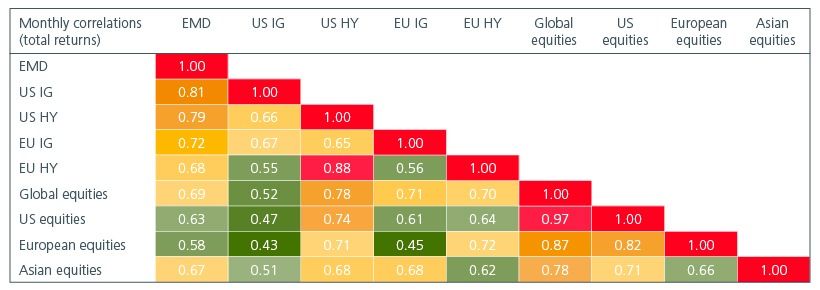
Greater diversification. EMs comprise of over 70 countries that are highly diverse in terms of economic structure, demographics and stages of development. As such, EMD is not dependent on one macro path and can offer greater portfolio diversification. Our analysis shows that EMBIGD returns have a weak correlation (0.32) with US Treasuries, and lower correlations with other major equity markets than comparable US and European High Yields. Fig. 7.
Fig. 7. EMD’s low correlations improve portfolio diversification
Source: Monthly correlations (total returns) – Jan 2006 – June 2026. Bloomberg. Eastspring Investments. JP Morgan EMBI Global Diversified Composite. Bloomberg US Corporate Bond Index. Bloomberg US Corporate High Yield Bond Index. Bloomberg Pan-European Aggregate Corporate Index. Bloomberg Pan-European High Yield Index. MSCI World. S&P 500 Index. MSCI Europe Index. MSCI AC Asia ex Japan Index.
Key takeaways
Reassess the EM-DM divide. Improving EM fundamentals and rising DM fiscal pressures are blurring the traditional distinctions between EMD and DM bonds.
Reframe EMD as a strategic complement to DM bonds. EMD can enhance income, provide access to a broader set of macro and credit opportunities as well as increase portfolio diversification.
Interesting reads











The information and views expressed herein do not constitute an offer or solicitation to deal in shares of any securities or financial instruments and it is not intended for distribution or use by anyone or entity located in any jurisdiction where such distribution would be unlawful or prohibited. The information does not constitute investment advice or an offer to provide investment advisory or investment management service or the solicitation of an offer to provide investment advisory or investment management services in any jurisdiction in which an offer or solicitation would be unlawful under the securities laws of that jurisdiction.
Past performance and the predictions, projections, or forecasts on the economy, securities markets or the economic trends of the markets are not necessarily indicative of the future or likely performance of Eastspring Investments or any of the strategies managed by Eastspring Investments. An investment is subject to investment risks, including the possible loss of the principal amount invested. Where an investment is denominated in another currency, exchange rates may have an adverse effect on the value price or income of that investment. Furthermore, exposure to a single country market, specific portfolio composition or management techniques may potentially increase volatility.
Any securities mentioned are included for illustration purposes only. It should not be considered a recommendation to purchase or sell such securities. There is no assurance that any security discussed herein will remain in the portfolio at the time you receive this document or that security sold has not been repurchased.
The information provided herein is believed to be reliable at time of publication and based on matters as they exist as of the date of preparation of this report and not as of any future date. Eastspring Investments undertakes no (and disclaims any) obligation to update, modify or amend this document or to otherwise notify you in the event that any matter stated in the materials, or any opinion, projection, forecast or estimate set forth in the document, changes or subsequently becomes inaccurate. Eastspring Investments personnel may develop views and opinions that are not stated in the materials or that are contrary to the views and opinions stated in the materials at any time and from time to time as the result of a negative factor that comes to its attention in respect to an investment or for any other reason or for no reason. Eastspring Investments shall not and shall have no duty to notify you of any such views and opinions. This document is solely for information and does not have any regard to the specific investment objectives, financial or tax situation and the particular needs of any specific person who may receive this document.
Eastspring Investments Inc. (Eastspring US) primary activity is to provide certain marketing, sales servicing, and client support in the US on behalf of Eastspring Investment (Singapore) Limited (“Eastspring Singapore”). Eastspring Singapore is an affiliated investment management entity that is domiciled and registered under, among other regulatory bodies, the Monetary Authority of Singapore (MAS). Eastspring Singapore and Eastspring US are both registered with the US Securities and Exchange Commission as a registered investment adviser. Registration as an adviser does not imply a level of skill or training. Eastspring US seeks to identify and introduce to Eastspring Singapore potential institutional client prospects. Such prospects, once introduced, would contract directly with Eastspring Singapore for any investment management or advisory services. Additional information about Eastspring Singapore and Eastspring US is also is available on the SEC’s website at www.adviserinfo.sec. gov.
Certain information contained herein constitutes "forward-looking statements", which can be identified by the use of forward-looking terminology such as "may", "will", "should", "expect", "anticipate", "project", "estimate", "intend", "continue" or "believe" or the negatives thereof, other variations thereof or comparable terminology. Such information is based on expectations, estimates and projections (and assumptions underlying such information) and cannot be relied upon as a guarantee of future performance. Due to various risks and uncertainties, actual events or results, or the actual performance of any fund may differ materially from those reflected or contemplated in such forward-looking statements.
Eastspring Investments companies (excluding JV companies) are ultimately wholly-owned / indirect subsidiaries / associate of Prudential plc of the United Kingdom. Eastspring Investments companies (including JV’s) and Prudential plc are not affiliated in any manner with Prudential Financial, Inc., a company whose principal place of business is in the United States of America.