







Hi, how can I assist?
Give me a summary of the article
Edge AI is emerging as the next phase of AI adoption, bringing intelligence closer to where data is generated and decisions are made.
Growing inference workloads, automation trends and demand for real-time processing are supporting rapid growth in edge AI.
Asia’s leadership across the edge AI value chain creates compelling investment opportunities as AI adoption expands into everyday devices and machines.
The Artificial Intelligence (AI) story is no longer confined to data centres and cloud infrastructure. Increasingly, AI is being embedded into everyday devices and machines. This is driving the rise of edge AI, which brings computing closer to where data is generated, enabling faster, more responsive applications.
From smartphones and laptops to industrial equipment and autonomous systems, edge AI allows devices to process data locally and act in real time. As a result, real-world systems are becoming smarter, more efficient, and increasingly automated.
While edge AI is well suited to applications that require real-time decisions and local processing, the cloud continues to provide the scale, storage and computational power needed to train and deploy increasingly sophisticated AI models. Rather than replacing the cloud, edge AI extends its capabilities, with both cloud and edge working together to support a growing range of AI applications.
What are the growth drivers of edge AI?
Beyond reducing latency, edge AI can improve reliability in environments where connectivity is limited, while keeping sensitive consumer and government data closer to its source may strengthen privacy and security. This is becoming more important as AI regulation evolves. Cost is another important consideration. Not every AI task requires the computing power of a data centre, and running smaller models directly on devices can reduce bandwidth requirements, lower power consumption, and improve efficiency.
As the AI market shifts from training to inference, the economics increasingly favour edge AI. Since inference occurs every time AI is used, supporting billions of daily interactions solely through centralised cloud infrastructure becomes increasingly costly. Large scale data centres also require substantial amounts of electricity, water and cooling capacity, raising questions around sustainability and resource efficiency.
The case for edge AI too extends beyond the technology benefits. Structural challenges such as ageing populations, labour shortages and the need for greater productivity are accelerating the adoption of automation across industries. At the same time, data volumes are expanding rapidly, while the sheer number of decisions required is outpacing human capacity to process them. Edge AI helps bridge this gap by enabling devices and machines to analyse information and act autonomously at scale.
Which segment of edge AI is growing rapidly?
Industry forecasts consistently point to strong double-digit growth for edge AI. Supporting this trend, International Data Corporation (IDC) projects global spending on edge computing solutions to reach US$261 billion in 2025 and rising to US$380 billion by 2028. This growing investment in edge infrastructure is expected to provide a foundation for the wider adoption of edge AI applications.
Hardware currently represents the largest share of the edge AI market, driven by growing demand for AI-enabled devices such as smartphones, PCs, smart cameras, industrial robots, sensors, and edge servers. Fig 1. Meanwhile, edge cloud infrastructure is expected to grow the fastest as companies increasingly deploy AI and connect thousands of devices across factories, offices, and other locations.
Fig 1: Global edge AI market size by component (forecast till 2033)
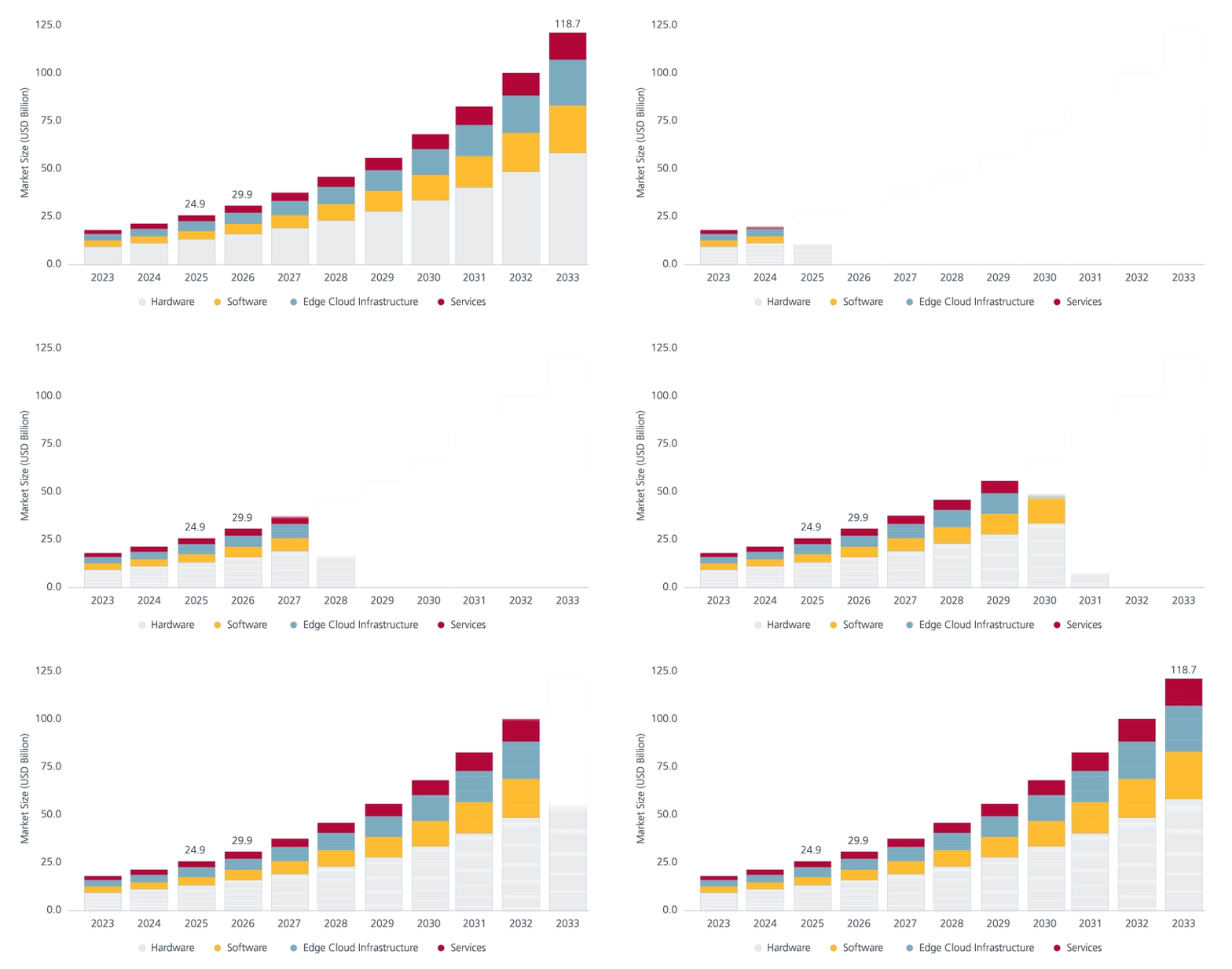
Source: Grandview Research, 2025
Asia is expected to be the fastest-growing edge AI market. The region combines a comprehensive semiconductor and electronics ecosystem with rising adoption across smartphones, vehicles, factories, and telecommunications networks. Continued investment in smart manufacturing, robotics, 5G and connected infrastructure is further accelerating deployment across China, Japan, and South Korea.
What is Asia’s role in edge AI?
Edge AI broadens the AI opportunity set beyond data centres and cloud infrastructure, creating opportunities across the wider technology value chain, including device makers, semiconductor companies, memory suppliers, industrial automation firms, and networking providers.
Asia is uniquely positioned to benefit from edge AI. The region manufactures many of the chips, memory, sensors, and electronic components that enable edge AI, while also representing a major market for smartphones, electric vehicles, industrial automation, and smart manufacturing. Fig 2. This combination of manufacturing strength and end-market demand creates a compelling investment opportunity.
Fig 2: Asia benefits at every stage of the edge AI value chain from components to consumers

Source: Eastspring Investments. July 2026
Today's edge AI applications largely enhance existing devices by making them smarter, faster, and more responsive. However, the next stage of AI evolution goes a step further. Rather than simply assisting users, AI systems will increasingly interact with and act upon in the physical world.
This shift gives rise to physical AI, where robots, autonomous machines and intelligent systems must perceive, reason and act in real time. Such capabilities are only possible because of edge AI. For investors, understanding edge AI is therefore important not only because of its own growth potential, but because it provides the technological foundation for the next phase of the AI revolution.
This article is the fourth in a five‑part series on the AI technology cycle and the investment opportunities in Asia as the cycle evolves and matures.
Look out for the final article in this tech series, "Why Asia is the investment sweet spot in physical AI", where we explore how edge AI is enabling the rise of robotics and autonomous systems across Asia.
Interesting reads




The information and views expressed herein do not constitute an offer or solicitation to deal in shares of any securities or financial instruments and it is not intended for distribution or use by anyone or entity located in any jurisdiction where such distribution would be unlawful or prohibited. The information does not constitute investment advice or an offer to provide investment advisory or investment management service or the solicitation of an offer to provide investment advisory or investment management services in any jurisdiction in which an offer or solicitation would be unlawful under the securities laws of that jurisdiction.
Past performance and the predictions, projections, or forecasts on the economy, securities markets or the economic trends of the markets are not necessarily indicative of the future or likely performance of Eastspring Investments or any of the strategies managed by Eastspring Investments. An investment is subject to investment risks, including the possible loss of the principal amount invested. Where an investment is denominated in another currency, exchange rates may have an adverse effect on the value price or income of that investment. Furthermore, exposure to a single country market, specific portfolio composition or management techniques may potentially increase volatility.
Any securities mentioned are included for illustration purposes only. It should not be considered a recommendation to purchase or sell such securities. There is no assurance that any security discussed herein will remain in the portfolio at the time you receive this document or that security sold has not been repurchased.
The information provided herein is believed to be reliable at time of publication and based on matters as they exist as of the date of preparation of this report and not as of any future date. Eastspring Investments undertakes no (and disclaims any) obligation to update, modify or amend this document or to otherwise notify you in the event that any matter stated in the materials, or any opinion, projection, forecast or estimate set forth in the document, changes or subsequently becomes inaccurate. Eastspring Investments personnel may develop views and opinions that are not stated in the materials or that are contrary to the views and opinions stated in the materials at any time and from time to time as the result of a negative factor that comes to its attention in respect to an investment or for any other reason or for no reason. Eastspring Investments shall not and shall have no duty to notify you of any such views and opinions. This document is solely for information and does not have any regard to the specific investment objectives, financial or tax situation and the particular needs of any specific person who may receive this document.
Eastspring Investments Inc. (Eastspring US) primary activity is to provide certain marketing, sales servicing, and client support in the US on behalf of Eastspring Investment (Singapore) Limited (“Eastspring Singapore”). Eastspring Singapore is an affiliated investment management entity that is domiciled and registered under, among other regulatory bodies, the Monetary Authority of Singapore (MAS). Eastspring Singapore and Eastspring US are both registered with the US Securities and Exchange Commission as a registered investment adviser. Registration as an adviser does not imply a level of skill or training. Eastspring US seeks to identify and introduce to Eastspring Singapore potential institutional client prospects. Such prospects, once introduced, would contract directly with Eastspring Singapore for any investment management or advisory services. Additional information about Eastspring Singapore and Eastspring US is also is available on the SEC’s website at www.adviserinfo.sec. gov.
Certain information contained herein constitutes "forward-looking statements", which can be identified by the use of forward-looking terminology such as "may", "will", "should", "expect", "anticipate", "project", "estimate", "intend", "continue" or "believe" or the negatives thereof, other variations thereof or comparable terminology. Such information is based on expectations, estimates and projections (and assumptions underlying such information) and cannot be relied upon as a guarantee of future performance. Due to various risks and uncertainties, actual events or results, or the actual performance of any fund may differ materially from those reflected or contemplated in such forward-looking statements.
Eastspring Investments companies (excluding JV companies) are ultimately wholly-owned / indirect subsidiaries / associate of Prudential plc of the United Kingdom. Eastspring Investments companies (including JV’s) and Prudential plc are not affiliated in any manner with Prudential Financial, Inc., a company whose principal place of business is in the United States of America.